

.webp?language=en-US)



by Scott Keyes
The National Park Service and ASLA are pleased to congratulate the winners of the 15th annual Historic American Landscapes Survey (HALS) Challenge competition. This year’s winners were officially announced at the ASLA Conference on Landscape Architecture on Tuesday, October 8, 2024.
Administered by the National Park Service, in collaboration with the ASLA and Library of Congress, the HALS Challenge competition encourages landscape architects, students, and other interested parties to document historic landscapes in their communities. To enter the competition, participants must complete a historical report that highlights the history, significance, and character-defining features of the surveyed landscape. This report can be supplemented with measured drawings or large-format photographs. All competition entries are archived in the HALS collection at the Library of Congress where they contribute to the nation’s largest repository of documentation on American architecture, engineering, and landscapes.
This year’s HALS Challenge was an open competition. Historic landscapes encompass a vast array of diverse property types and places, from formal gardens, parks, and public spaces to traditional cultural places, vernacular communities, and residential districts. To reflect this diversity, we invited landscape architects, historians, students, and others to document any landscape that would make a good addition to the collection.
The competition resulted in the donation of 10 impressive surveys to the HALS collection. A jury composed of National Park Service historians and landscape architects reviewed the entries and selected the following winners.
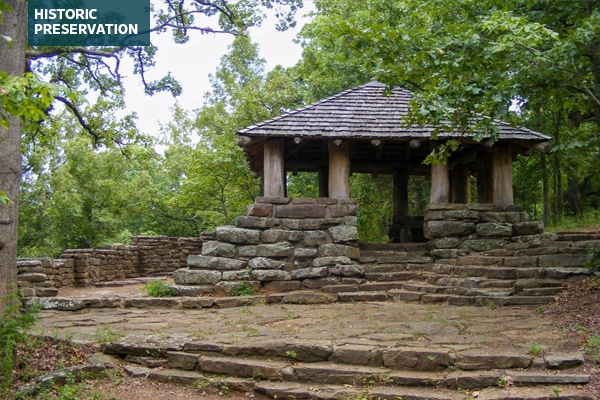
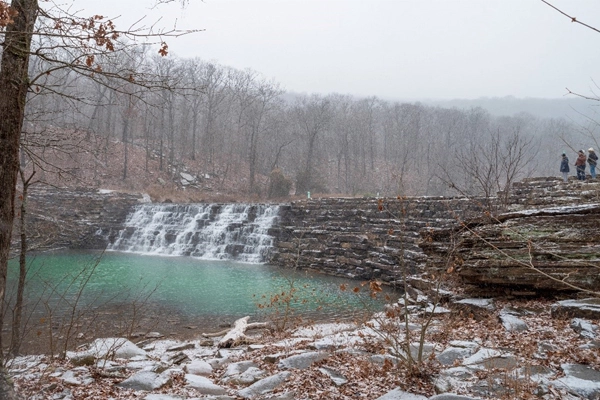
First Place: Devil’s Den State Park, HALS AR-13 West Fork vicinity, Washington County, Arkansas By Kimball Erdman, Lori Filbeck, Allen Hart, Sophia Bobzien, Student ASLA, Andreia Alfaro, Emily Booth, Matthew Gauldin, Student ASLA, Brett Paris, Reed Waters, Angie Payne, Malcolm Williams, Manon Wilson; Fay Jones School of Architecture + Design and the Center for Advanced Spatial Technologies, University of Arkansas
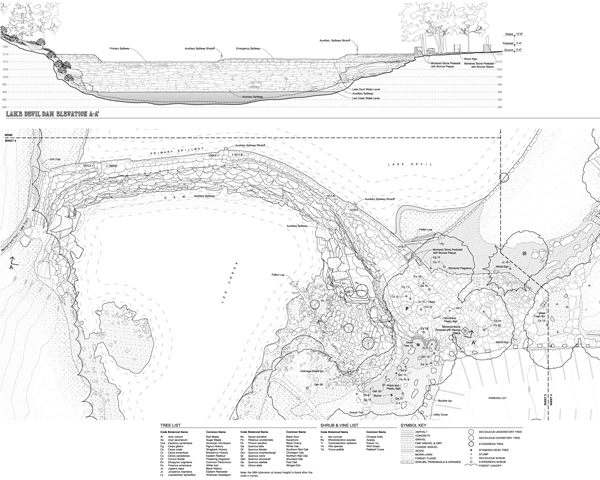
Devil’s Den State Park is one of Arkansas’ first six state parks, all of which were designed and built by the Civilian Conservation Corps. As with other state and national parks of this period, all built elements in the park, including buildings, roads, trails, bridges, dams, signage, furniture, and many other features, were designed in the National Park Service Rustic style. The park is widely regarded as the most intact example of CCC design in Arkansas and still serves as a national exemplar of Rustic style design. HALS documentation of this landscape provides both a general overview of the park and detailed examinations of several representative areas with high historic significance. In addition to the extensively researched historical report, the survey includes a full set of measured drawings.
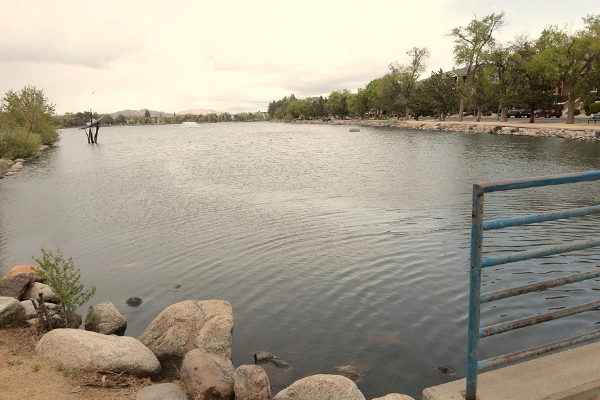
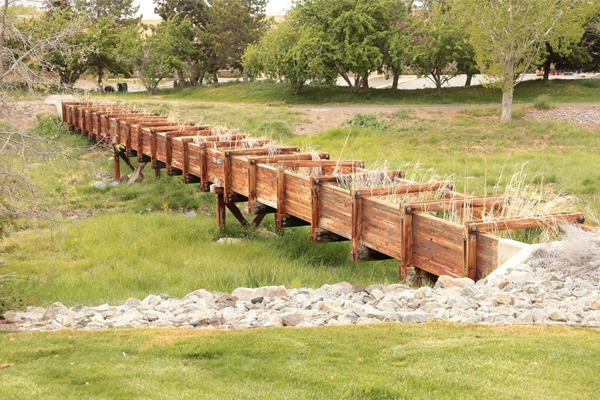
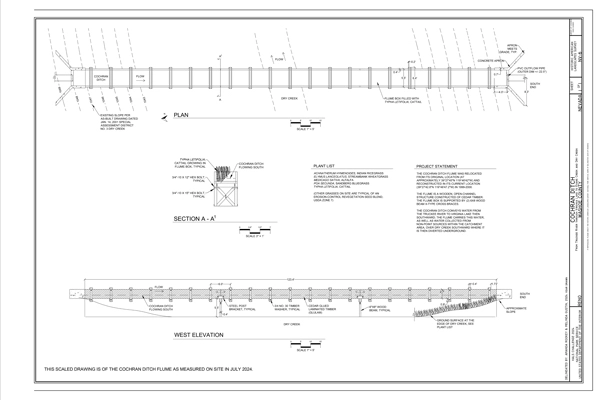
Second Place: Cochran Ditch, HALS NV-6 Reno, Washoe County, Nevada By Dr. Jung-Hwa Kim and Jacel Zeres Avila, Student ASLA, UNLV School of Architecture; Amanda Rookey, ASLA; and Melinda Gustin, ASLA
The Cochran Ditch, one of Reno’s first irrigation ditches, represents the establishment of water systems crucial for meeting the growing agricultural needs of the burgeoning city during the nineteenth century. The HALS documentation summarizes the history of the resource and identifies key features along the length of the site, including measured drawings of the Cochran Flume, one of the landscape’s primary built elements.
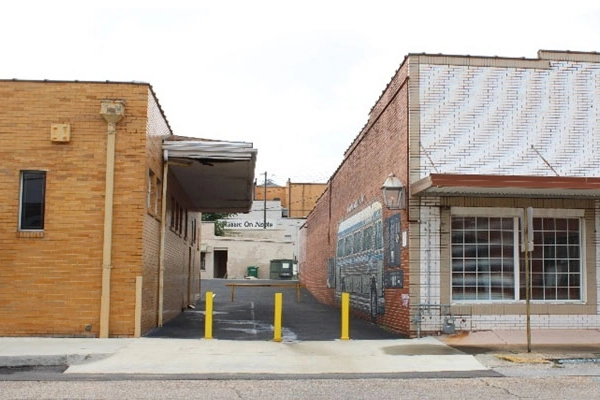
Third Place: Freedom Riders National Monument, HALS AL-9 Anniston, Calhoun County, Alabama By Laura L. Knott, FASLA
The Freedom Riders National Monument encompasses two sites associated with the 1961 segregationist attacks on a Greyhound bus carrying a group of “Freedom Riders” travelling from Washington, DC to New Orleans to challenge segregation laws in interstate travel. The bus was attacked at the bus depot in Anniston and subsequently firebombed after it was forced to stop in front of Forsyth & Son Grocery. Media coverage of the attack bolstered the civil rights movement and inspired many to become activists in voter registration, Freedom Schools, and the Black Power movement. The HALS documentation includes a detailed historical narrative, analysis of the landscape’s integrity, and site plans showing the historic and current conditions of the two sites.
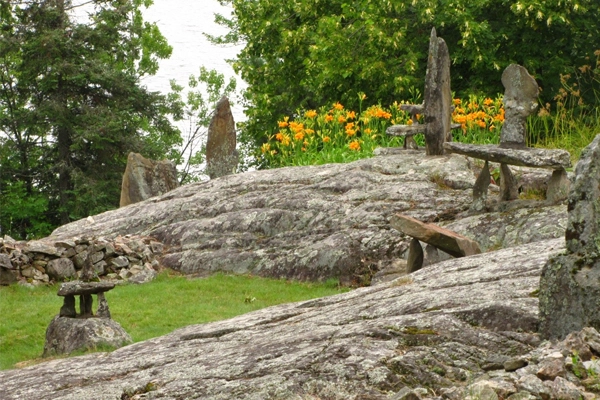
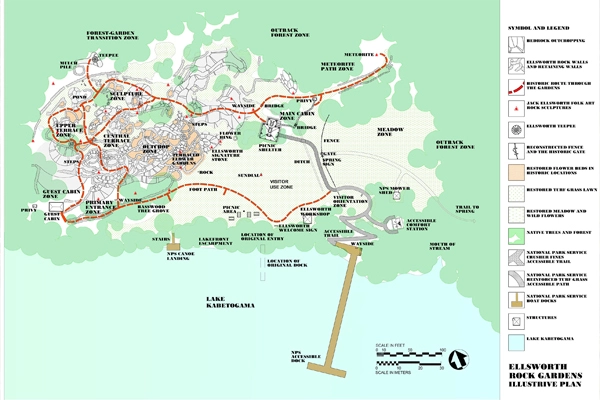
Honorable Mention: Ellsworth Rock Garden, HALS MN-13 Kabetogama Township, Saint Louis County, Minnesota By David Driapsa, FASLA
The Ellsworth Rock Garden is a significant and unique twentieth-century folk-art landscape. Jack Ellsworth, the garden’s creator, used natural elements of the native landscape to create an original and distinctive art environment. Over a period of twenty years, Ellsworth constructed 62 terraced flower beds on a prominent outcrop, which he filled with more than 13,000 lilies and other flower varieties. He then accented his garden landscape with over 200 abstract rock sculptures. The HALS documentation includes an informative historical report and illustrative site plan.
In addition to these winners, the competition received six other outstanding entries, listed alphabetically by state:
- California Governor’s Mansion State Historic Park (CA-177); Sacramento, California; by Melissa Mourkas
- Muncie Municipal Parks (IN-18); Muncie, Indiana; by Dieudonne Kwizera, Associate ASLA, and Dorna Eshrati, PhD, Affiliate ASLA, Estopinal College of Architecture and Planning, Ball State University
- Hovey & Co. Nursery (MA-11); Cambridge, Massachusetts; by Allison A. Crosbie, ASLA
- Mayowood (MN-12); Rochester, Minnesota; by A. Graham Sones, ASLA
- Village of Bainbridge (OH-18); Paxton Township, Ohio, by David Driapsa, FASLA
- Deep Lock Quarry (OH-19); Village of Peninsula, Ohio; by P. Jeffrey Knopp, ASLA
The Historic American Landscapes Survey (HALS) was created in 2000 as a federal program to document historic landscapes throughout the United States. Documentation, consisting of drawings, photographs, and historical reports, is archived in the Library of Congress where it is available to the public copyright free. Like its companion programs, the Historic American Buildings Survey (HABS) and the Historic American Engineering Record (HAER), HALS documentation is used by a variety of constituents to study and preserve our nation’s significant historic sites.
The National Park Service administers HALS and develops uniform guidelines for recording landscapes, the ASLA provides professional guidance and technical advice for the program through its Historic Preservation Professional Practice Network, and the Library of Congress preserves HALS documentation and makes records available to the public.
HALS will continue the HALS Challenge in 2025, the Historic American Landscapes Survey’s 25th anniversary year, inviting all landscape architects, historians, students, and other interested parties to document significant cultural landscapes in their communities. To enter the competition, please submit a short format historical report to the HALS program no later than July 31, 2025 (c/o Scott Keyes, [email protected]). Cash prizes will be awarded to the top three submissions and the results will be announced at the ASLA 2025 Conference on Landscape Architecture in New Orleans. To learn more about the competition and other ways to contribute to the HALS collection, please visit the program website.
Scott Keyes is the Chief of the Heritage Documentation Programs and acting Chief of the Historic American Landscapes Survey at the National Park Service.