

.webp?language=en-US)

An Interview with Kofi Boone, FASLA, Joseph D. Moore Distinguished Professor of Landscape Architecture and Environmental Planning and founder of the Just Communities Lab at North Carolina State University
Interview by Eve Anderson, ASLA
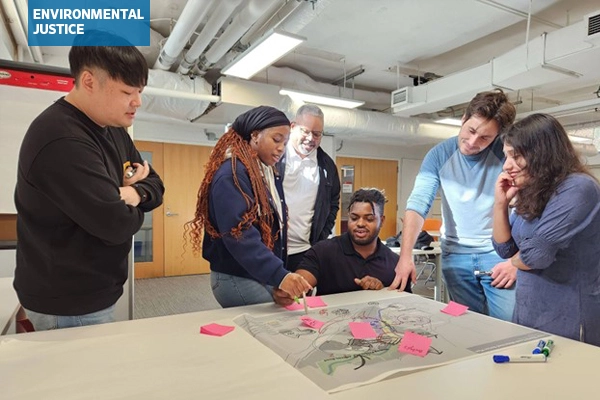
The Environmental Justice Professional Practice Network (PPN) is honored to share this interview with Kofi Boone, FASLA, a celebrated professor and scholar whose work in environmental justice and community-engaged design has profoundly impacted both academic and professional practice. Kofi recently formed the Just Communities Lab at North Carolina State University, where he and his students advance environmental justice (EJ) strategies in landscape architecture by collaborating with impacted communities.
I was super excited, as was the PPN, to learn about the Just Communities Lab at NC State. And so, Kofi, I would like to start by asking, what is the mission of the Just Communities Lab?
The emphasis is on co-creation with communities, and supporting the impact of environmental strategies through what we do in design and planning. So part of it is technical assistance for communities, and part of it is scholarship and research. We’re engaged in grant projects that, quite frankly, aren't directly community engaged, but deal with data and analysis to establish methodologies and approaches that we can use. But at its core, you know, we either do funded research work or the pro bono sort of technical assistance by community invitation. The goal is to map out together with the communities affected, step by step, how they want to proceed. Trying to engage in this kind of work previously, it was done either purely through funded research projects or in the classroom. And in both cases, there are some constraints. In the classroom, we did a lot of really impactful, meaningful work. But we were really working within the timeframe of a semester, and it was dependent on the skill or interest level of students and what their educational missions were. The lab became an opportunity to open EJ work up to more folks beyond a single semester.

Can you describe who is part of the lab?
Right now, there's probably four people from the College of Design engaged in the lab who are graduate Research Assistants. There’s one postdoc, Dr. Dong-Jae Yi, who just finished his PhD in design, who's also teaching part time in the department, and he handles the more intensive work, but there are four people in addition to me. And we have partnerships with communities, across the state, and different disciplines as well.
You mentioned that one of the benefits of the lab structure and not necessarily tied to a design studio is that a project can live longer than a semester. What is the typical life cycle of a project?
Some of the work we’re doing now predated the formal creation of the lab. And in that regard, some of the community pro bono engagement work is indefinite—there's no end to it. It's a relationship that's been built and as long as we're all able, we're gonna work together. For funding research grants, you're dealing with specific parameters, but those are all at least three years. The pro bono stuff, or unfunded work that we do, is usually based on an invitation by a community saying, “Hey, we got an issue, and we think some technical assistance would help us think through it and figure it out.” And we develop a sort of memo of understanding to make sure everybody is on the same page. As long as we can co-create and determine what we're doing, how we're doing it, who's involved, and who benefits, then we can proceed. There's a number of projects that we've been working on for almost 10 years. And we're just going to keep working on them.
I'm hearing you describe this engagement methodology of co-creation—can you elaborate on this concept and how it might differ from what community engagement sometimes looks like for landscape architects? What is the lab doing differently in that regard?
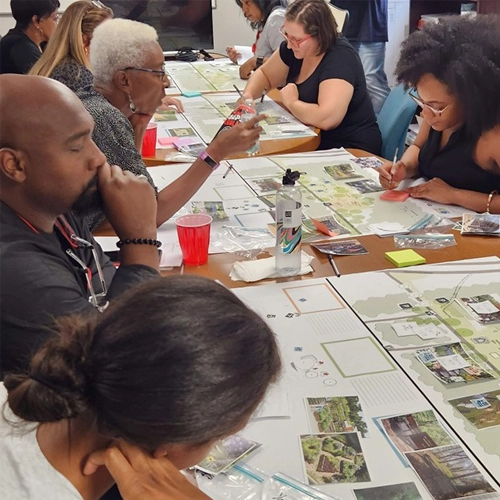
I think that the summer 2020 was a wakeup call to a lot of folks about the glaring inequalities and disadvantages in our society and the field. Co-creation is a buzzword, you know, it really doesn't mean much of anything, but our process comes from a tradition of community-based participatory research. Its actual model comes from public health and related fields. To translate that model to landscape architecture, you start with building relationships, building trust in advance of a project. In some of our community work, there was no project before we were involved—instead the project originates by getting a sense of the needs of the group and the needs of a place. The benefit of that relationship building early on is trust through the process, and so when you hit bumps in the road, or there's divergence, or you're faced with a new challenge, and there's a crisis, you've already established some very deep relationships that allow people to weather the storm and keep moving forward. So I would say that that's probably the biggest difference.
It’s important to realize that as professionals, we have access to technical information that a lot of community folks don't. And so when they see flooding somewhere, or there's something weird going on with the soil, or there’s no trees in a neighborhood, it's hard to understand that there's data associated with those, there's methods associated with those, there's policies that you can leverage to access things for change. In some cases, it's just sort of getting to know people—and so that's different. I think that from a landscape architect standpoint, so much of our work is based on a fee for service or a professional corporate model, or a public agency model where there are real fast and hard guidelines and deliverables that you got to have. We have the space to let conversations and relationships evolve as they need to.
What does your current list of projects look like? How many do you have at a given time?
We currently have five active projects. Often when we think about environmental justice, we think of hazards—poor air quality, flooding, water, contaminated soil quality, things of that nature. Our current cache of projects really focuses more on assets, and how communities can become more aware and advocate more strongly to protect, enhance, and invest in their assets.
Can you describe one of your projects?
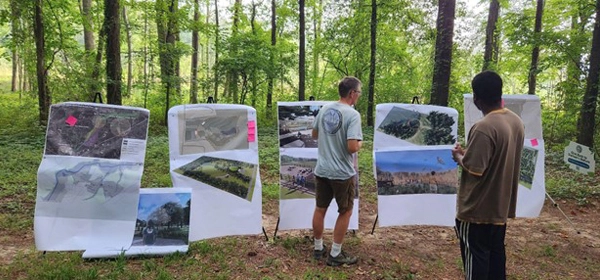
One example is Catawaba Trail Farm, just north of the city of Durham, North Carolina. It’s owned and run by Urban Community AgriNomics, which is a nonprofit organization that emerged 20 years ago to teach people about life skills using the landscape. It's all run by black women, senior black women, who asked permission from the Triangle Land Conservancy a decade ago, to farm and cultivate on what was once known as the Snow Hill Plantation. It was a transfer of land ownership from the Triangle Land Conservancy to this nonprofit to not just steward, but to own the land. The people leading this nonprofit are descendants of the enslaved people that used to work that plantation. The work started when they needed help laying out garden beds and fencing. Then it grew into telling the story about the significance of the place, and supporting them while they acquired the land. So the work has evolved with them in parallel as they’ve grown. Currently we're working on an unmarked burial ground that was discovered on this site. We collaborated with a researcher at Duke University, Brian McAdoo, to use ground penetrating radar to identify where we think the graves of former enslaved peoples are, and we're working on a protection and interpretation strategy. This work has gone on for seven, eight years, you know, starting as undefined individual pieces, and then eventually started to ratchet into work on the complete opposite end of the spectrum.
What impact do you believe working in the lab has had on students?
What I hope they've learned is—not to devalue the studio environment for taking on these issues—but I think sometimes to do your project, you assume you’re solving everything in 16 weeks. And you know, the really good studios, I think, know how to plug in that 16 weeks worth of effort into a longer term approach. I'm hoping that they understand that as much as the technical skill set of landscape architecture matters, because you don't want to harm anybody by doing stupid stuff, it’s important to demystify the people and the places involved in this work. A lot of the students that we worked with don't have firsthand direct lived experience with issues of environmental justice, or the communities that face them. So there's sometimes a sort of shock and awe thing at first in terms of like, “Whoa, you know, this whole thing is completely different from anything that I can relate to. I want to participate, but I'm just so overwhelmed. I don't know what to do.” And so the idea of experiencing the small iterative steps and relationship building and thinking over a longer time frame is important. The lab also emphasizes impact—you don't want to waste people's time, you want to deliver something, even if it's a policy recommendation or something to pass on to others. That reveals something bigger than what you can get into in a class setting.
You mentioned that co- creation is kind of a buzzword that popped up in the field after the Black Lives Matter movement began in 2020. How do you think our field can more meaningfully engage with concepts of environmental justice beyond plugging buzzwords?
For people who are interested in working with communities, part of that relationship building is not having a savior complex, and acknowledging that the environmental design and building professions have actually done an incredible amount of harm to the world around us. We're not coming in with clean hands, per se. Sometimes the recognition of previous planning decisions, like where we put a road, who decided on zoning, who got access to a park, who let this community get built in the floodplain and get destroyed—the acknowledgment this profession contributed to some of these situations is something I think is important to conceptualize. I’ve also found that most communities that I work with have no idea what landscape architecture is, but they understand the benefits that we produce. Focusing on those: the health benefits, the community benefits, the nature-based solution approach, would be more practical. Not necessarily leading with landscape architecture, but leading with the benefits that we enable through our work, because that's more accessible to people.
I also think we could do more to creatively advocate against disproportionate harms to communities. I think that some landscape architects are risk averse—they might not get up in the middle of a Senate hearing and read a paper. But by sharing evidence, to say that a decision resulted in X, we can be in a position of helping people understand the cost, the trade-offs and the benefits, of different decisions that could do people great harm—and centering people from those communities that are affected. We just have a long way to go to have our profession reflect the communities that we serve and elevate people who are doing it well.
From a tactical point, the EPA’s Thriving Communities Tactical Assistance Program takes federal money and funnels it through regional centers that have already been identified. And those regional centers are supposed to maintain local continuity with communities. Think of them like these regional clearing houses, instead of going to Washington for everything you can go, in our case in North Carolina, to RTI and RTP. These centers are going to receive a lot of these federal resources moving forward. And they're going to kind of steward the development of these local environmental justice networks. So I would say for landscape architects: figure out where your closest center is, and just get to know what they're doing and see what's on the horizon.
Do you have any advice for educators or people working in the academic space who want to get involved in projects like the Just Communities Lab?
Yeah, you know, the lab experience is new for me too. I'm not going to speak from any kind of expertise, I’m making it up as I go along, just like everybody else. But I would say, the hardest part about the academic space is to produce scholarship that is recognized by the academy, but still has value to the community. And we're often in a position where those are at odds. The kinds of rewards that we get as academics are completely meaningless to community folks. And authentic, impactful work that landscape architects do on the ground—if we don't wrap it up in good research methods found in the academic world, they're like, “Oh, that's cool, but that's service, that's not really scholarship.” Walking that line between the two so the academy has what it needs to continue the work, and the community doesn't feel like they’re being exploited. I guess a more tangible bit of advice would be to, before you get started, take baseline information about the project so you can measure how things change after you're done, that's something we often don't do. And this is gonna sound really academic, but think about a question that you're trying to answer throughout different aspects of the work.
What's your vision for the future of the lab? How could it grow and change and evolve?
I think it made sense to start with a focus on landscape architecture and environmental planning, and to build some capacity and depth to be able to communicate to communities what we can do, because we're still unknown by a lot of communities, I think. That work will continue. But the nature of the problems we're facing are so complicated—it's beyond the purview of a single profession. This isn't rocket science. Since the mid-20th century, we’ve had Hideo Sasaki and other folks saying, “We can't just have a bunch of landscape architects in here, we got to have environmental professionals and specialists.” I think with environmental justice, it's those professions but it's also a lot of social science expertise. So eventually, I'm hoping to bring public health expertise into the lab. My hope for the future is to create some space to enable public health to be equal to the landscape architecture component, so we can continue building meaningful relationships. Right now, we work with those fields in partnership. But I think it would be a different dynamic if projects were approached holistically with those perspectives.
Is there anyone else in the field who you feel like is doing critical EJ work?
There's a lot. In some cases, it's not like direct environmental justice type stuff. But yeah, there's a lot I think Billy Fleming is a good friend, you know, and what the McHarg Center is doing at Penn—what's important about it is we don't have enough landscape architects thinking about policy. We often think at the scale of the project and try to scale up, but they're thinking from a policy level and how to scale down. I like what Diane and Austin do at DesignJones. I had a chance to work with them a bit in New Orleans, and they've done great work. Deb Guenther, FASLA, and her crew at Mithun in Seattle, and their work with First Nations and native people, finding ways to integrate indigenous knowledge in their process. I did some small consulting with Field Operations, who previously I would never consider in regard to environmental justice, but what they did with the Reimagine Middle Branch Plan in Baltimore, that vision plan and the commitment to really disseminating resources, information, and engaging local people over a long period of time, even during the pandemic, I think was fantastic. And Tim Duggan, ASLA’s work at Phronesis in Kansas City, what he's done at Vine Street is pretty remarkable and he’s taken that model to different parts of the country and the world. There's folks out there that are doing it. With regards to academic work, the Detroit Collaborative Design center at University of Detroit Mercy has done some amazing work in this arena.
Kofi will be presenting two sessions at the ASLA 2024 Conference on Landscape Architecture: Youth-Led Community Resilience: Trauma-Informed Practices Fostering Equitable Development and Reframing the Plantation Narrative: A Community-driven Evolution of Latta Place. Register today to join us in Washinton, D.C., this October!
Eve Anderson, ASLA, is an urban designer working in the triangle region of North Carolina. She is passionate about environmental justice and novel modes of making within the field, including deeply subjective modes like narrative exploration and speculative world-building. She is currently working on a contribution for an anthology that explores design research for uncertain futures.