

.webp?language=en-US)


by Arnaldo D. Cardona, ASLA
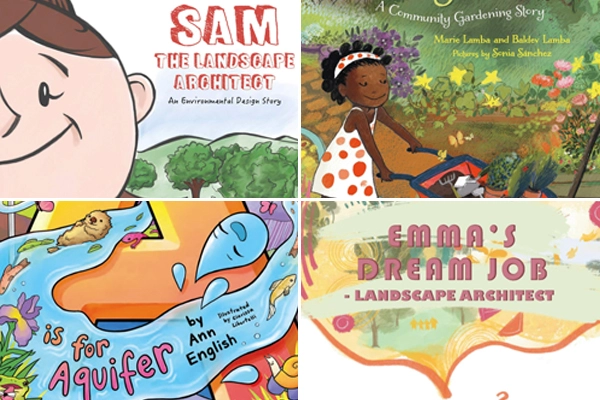
Is STEM a hands-on experience exclusively, or can it also be a literacy experience? The answer is emphatically the latter! To support ASLA’s STEM Literacy by Design initiative, I had the joy to lead a read-aloud at Crestview Elementary School in Henrico County, Virginia. The books I used for this read-aloud were:
Green Green: A Community Gardening Story, by Baldev Lamba, ASLA, and Marie Lamba
Sam The Landscape Architect: An Environmental Design Story, by Shannon Gapp, ASLA, Bolton & Menk
Both read-alouds were with Ms. Elizabeth C. Lee’s second-grade class. The school’s guidance counselor, Ms. Tera Koch, kindly helped me coordinate visiting the class.
Through both books, children were able to develop the following literacy skills:
- Content Prediction
- Letter Recognition
- Beginning and Ending Sounds
- Rhyming Word Recognition
- Retelling
- Summarizing
- Reading Comprehension
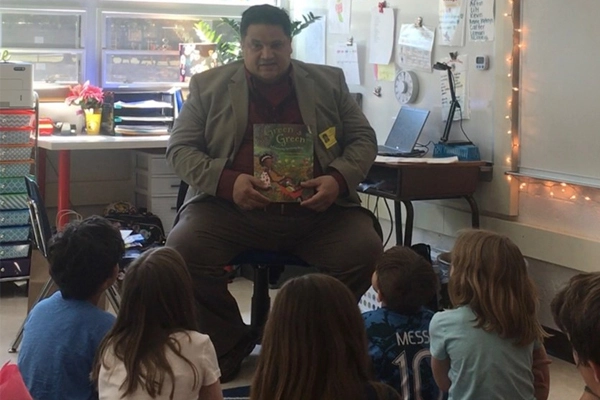
Besides these children gaining literacy skills through these books, they also gained awareness of the importance of becoming stewards of the environment and getting involved in community solutions and actions. It was rewarding to witness how students realized that in cities, vacant spaces should not be a depository of trash and that instead they can be outdoor rooms that can be planted with pollinators and edible plants. Some even expressed that instead of cities looking gray and dark, they should be green! When asking them how this can be achieved, it was very gratifying hearing their suggestions on how community members should get together and create gardens that will benefit us all.
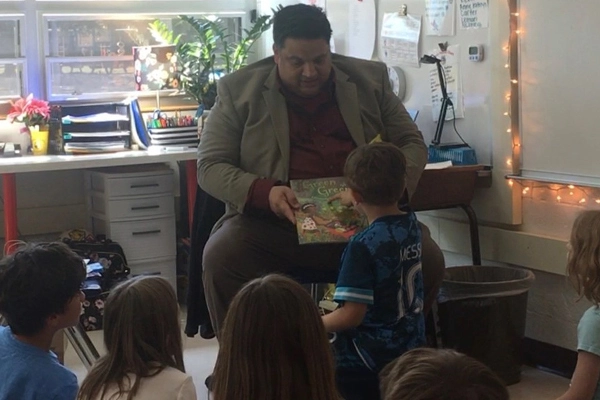
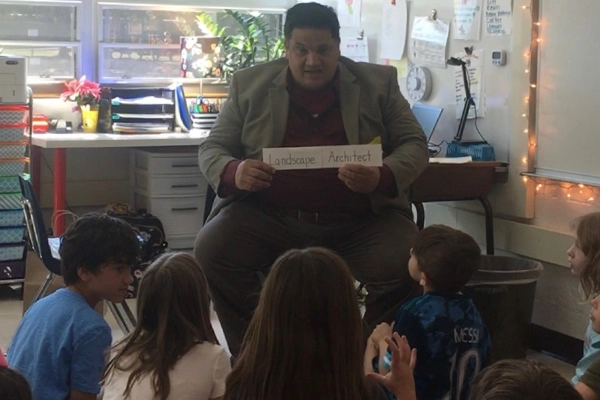
It was at this moment that I introduced the children to how landscape architects can help make cities greener. The term “landscape architect” was new to most of the students. After performing a word study strategy with the letters in the word “landscape architecture,” I told students that they can become landscape architects and design outdoor spaces that will attract living things and benefit all. I shared that landscape architects design parks, walkways, roads, pools, playgrounds, rain gardens; they restore wetlands, design pollinator gardens for butterflies and bees, and create sensory gardens to use our senses and healing gardens in hospitals. Landscape architects help reduce pollution and help plant trees to create a greener world.
Students’ reactions were so rewarding. They shared the importance of protecting our planet, communities, and neighborhoods by talking about personal experiences of how we need trees to produce the air we breathe, how important it is to have clean water so the plants that we eat do not have hazardous chemicals in them, and how important it is to have beautiful playgrounds to make new friends and see beautiful plants and flowers for the pollinators that help fruit trees produce delicious fruits.
I was amazed to see how these students are engaged in environmental issues that landscape architects work with. I shared that when designing outdoor spaces, landscape architects need to know a lot about science (plant taxonomy), technology (computers and problem solving), engineering (drainage, topography, and geography), and mathematics (measurements, geometry, and scale). I also mentioned that landscape architecture is a STEM profession, a fun profession, and the profession of the future! Because many cities are reaching their maximum building capacity, landscape architects bring natural elements to improve the way all living things live in harmony.
It was a joy to do this read-aloud with this great class. Even more rewarding was how landscape architects may become agents of change by motivating children to go green and be “landscape architecture forward.”
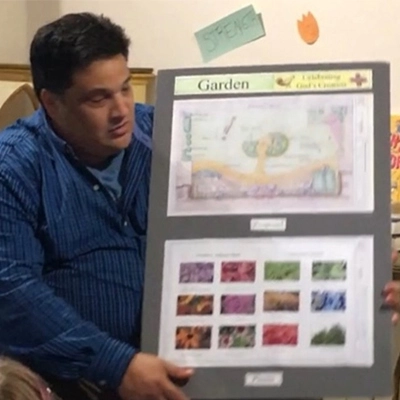
Doing this read-aloud let me introduce concepts to students that helped them get a better understanding of what landscape architects do. Furthermore, children gained awareness of the importance of landscape architects in the improvement of cities and communities. I showed them a planting plan that I produced in which ground covers, shrubs, and trees were illustrated to design a habitat restoration garden that uses only native plants. This will attract butterflies, insects, and birds that will turn the garden into a pollinator garden. This garden will also complement a rain garden next to it that channels all the water from a roof pipe and that, with the help of native grasses, will filter pollutants before getting incorporated into the surrounding ground.
To continue collaborating with this amazing school, I contacted Crestview’s PTA president to become a volunteer and to see if they would like to develop a STEM hands-on program using landscape architecture as a central theme. I can’t wait to meet Crestview Elementary’s principal to congratulate her for being the instructional leader of this school and developing a culture of collaboration and learning. I hope that this experience motivates school administrators to have “landscape architects in schools” so they can help preserve the outdoor spaces around their schools and also to help in literacy initiatives that promote STEM.
For more about ASLA’s STEM Literacy by Design initiative, please visit the ASLA website and explore the ASLA Career Discovery and Diversity webpage. Access the STEM Literacy by Design Guide (PDF) and instructional video with Arnaldo Cardona, ASLA, to learn more.
Arnaldo D. Cardona, ASLA, MS Ed., has been a member of the American Society of Landscape Architects (ASLA) since 2005. He served as a member of the ASLA’s Committee on Education and as chair of the subcommittee on K-12 Education. He is also the author of the book K-12 Landscape Architecture Education: An Interdisciplinary Curriculum Guide for Art, STEM and Vocational/Trade Educators. Mr. Cardona holds degrees and licenses in education and has taught courses and studios in landscape architecture, curriculum design, critical thinking, assessment in special education, and seminar courses, and has worked as a Student Supervisor of Art Education candidates at college level. Through this article he hopes to motivate other ASLA members to become advocates for career discovery initiatives and K-12 education in landscape architecture.