

.webp?language=en-US)




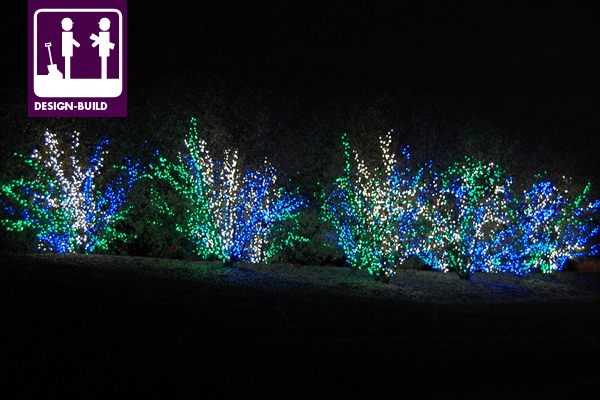
image: Reinders, Inc.
Many of us design-build practitioners occasionally find ourselves being asked by clients about providing holiday or event lighting design work, and the installations of said lighting. Recently, we had a request that spurred a challenge for us to implement lights for specimen trees. With a bit of research, we discovered some product data that might be helpful when future lighting requests arise.
Our company had a request from a client to provide decorative mini-lights for specimen trees that are located far from their driveway entrance. This also meant that it was far from any electrical outlets. With this challenge in mind, an area supplier introduced us to a really slick system for tying strings of LED lights directly into the wiring infrastructure of existing low-voltage or LED lighting systems. This allowed us to fill nearby ornamental trees and large shrubs with white or colored lights, by tapping right into adjacent cable from a path light or up-light, using quick coaxial couplers as the interface mechanism.
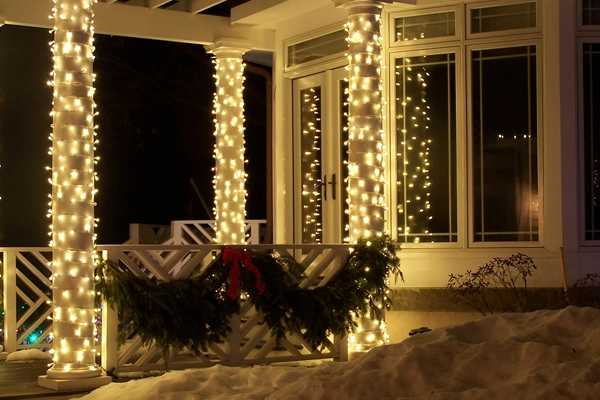
image: Reinders, Inc.
In addition to basic string lighting, we could add festive atmospheric lighting to pergolas, gazebos, and railings as well with this system. This included a variety of bulb sizes and color combinations. No ugly extension cords to hide or GFI outlets to add—it is too cool! The only wiring visible was a small-gauge green adapter wire which is the tie-in between the main cable line and the destination tree or structure being illuminated.
By implementing this energy-efficient technology, we lit a large Japanese tree lilac, a large fern-leaf beech tree, and a strand of cedar garland on an adjacent 70-foot-long motor court wall—with no voltage issues from tapping into the existing lighting cables near the trees and the wall (we knew we had a little wiggle room with available wattage).
Parking lot islands, gated entrances, even stringing light strands aerially over outdoor living spaces to add some magical ambiance to a special evening gathering—these are some great ways to use this handy technology. And last but not least, another great benefit is that these supplemental lights are automatically timed in to your landscape lighting system's digital clock.
Lots of possibilities with this simple system, so have some fun with this!
For more on the topic of lighting, home remodeling and design website Houzz has a number of stories on the subject:
Design Workshop: Cool Lighting Tricks
8 Effective, Beautiful Lighting Types for Front Yards
How to Choose the Right Solar Lights
Light Your Landscape for Drama and Function
9 Outdoor Lighting Schemes That Get Universal Design Right
The 3 Top Ways to Light Up Your Landscape
Wildlife-Sensitive Ways to Light a Coastal Landscape
by Chris Miracle, ASLA, and Tim Garland, ASLA, Design-Build PPN Co-Chairs