

.webp?language=en-US)



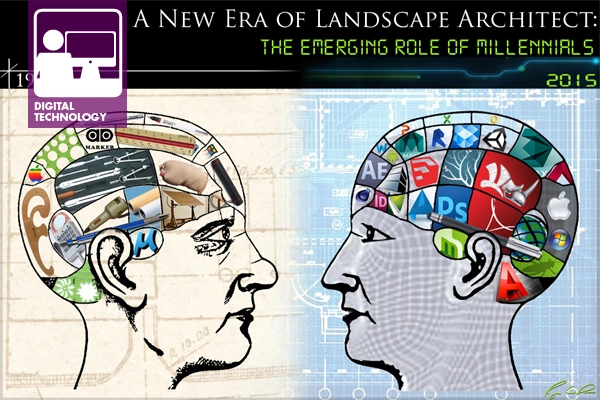
If your firm looks anything like mine it won’t be hard for you to paint this picture for yourself. A bustling open-office floor plan with large semi-private work stations for senior associates and principals along the windowed perimeter (usually vacant). Cookie cutter cubicles with low walls filled with a production army of 20-30 year olds, rocking headphones while heating up their keyboards, and an inner core of collaboration spaces filled with a mix of employees laboring over the latest design ideas – it won’t be long before these headphones (and their millennial owners) move towards those window seats.
Millennials Can “Just Play”
Back in the 80’s while many of our bosses were likely out at a Journey concert, we started training. Okay okay, at the time we didn’t know it was training, but opening an Atari, Nintendo, or Sega on your birthday was like getting your first PC. Then in the 90’s we sat down for hours on end to the ‘cutting edge’ graphics of “SimCity 2000," with only a keyboard and mouse to sculpt the landscape before planning a city… On second thought, it really was training! Between hours of playing “Oregon Trail” we wrote our first email from our 4th grade classroom on an Apple IIe. We typed our first book reports and inserted clip art in middle school, and by the time college rolled around we had early versions of AutoCAD, Photoshop, and GIS as part of our daily vocabulary.
Vocabulary is spot on when describing this. The beauty of our generation is that we all know at least two languages; our native tongue, and some capacity of a digital vernacular. Whether it’s word processing, drafting, modeling, graphic design, or writing code and algorithms, we all speak at least one of the dialects. I’m reminded of a scene from Good Will Hunting (1997). If you alter just one small line from this scene, it explains my point perfectly:
Will: Beethoven, okay. He looked at a piano, and it just made sense to him. He could just play.
Skylar: So what are you saying? You play the piano? Will: No, not a lick. I mean, I look at a piano, I see a bunch of keys, three pedals, and a box of wood. But Beethoven, Mozart, they saw it, they could just play. I couldn't paint you a picture, I probably can't hit the ball out of Fenway, and I can't play the piano. Skylar: But you can (model a site and spit out a 3D rendering) in under an hour. Will: Right. Well, I mean when it came to stuff like that... I could always just play.
We’re Integral to Success
I’d be willing to place a wager on how many times, every day, a computer savvy production LA is interrupted with a tech question (see open-office plan above). We’re team players so we don’t mind. It’s honestly a little compliment every time this happens. The skills we have from being very versatile make us huge assets to any organization. While it is within every individual’s capabilities to learn different technological skill sets, we are poised to redefine what it means to be a successful landscape architect. This means spreading our knowledge and skill sets to our colleagues to improve the collaborative dialect which ultimately makes our teams and process more efficient.
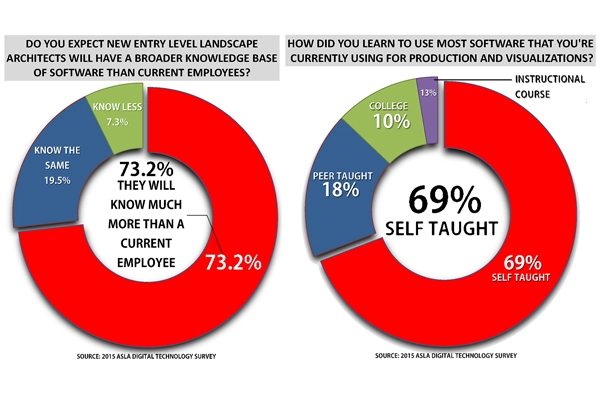
In 2014 Unity3D, an online realtime rendering platform, published a survey titled “The Future of Visualisation in Architecture.” The survey concluded that 93% of participants believed that 3D visualization and design communication technologies will become more integrated into workflows over the next 10 years. This was confirmed by the 2015 ASLA Digital Technology PPN survey yielding similar results of 77% supporting the growth of 3D visualization. Barring the anomalies of younger Gen-X tech savvy professionals, it is apparent who will be ushering in the change in this delivery process. (See more ASLA Digital Technology survey results below.)
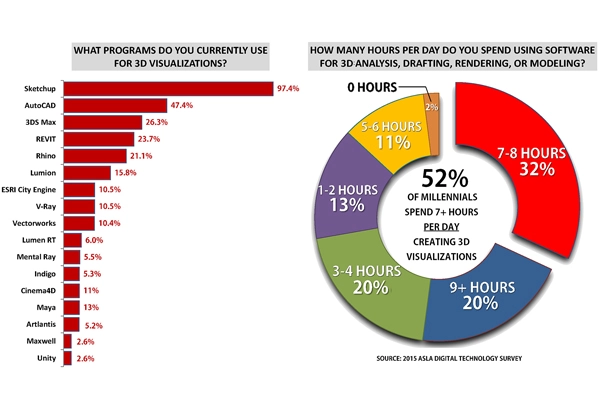
The caveat to the current roles in what will be the future of our profession is this – What happens when all the generals retire and we’re left with only grunts?
We’ve Got a Lot to Learn
There are many facets to the field of landscape architecture, so it is very important that millennials not only focus on one. The skills highlighted above are only necessary to efficiently analyze, synthesize, and produce the final product or deliverable. These processes will not hold meaning without due diligence, a solid design, a project manager, proper coordination, regulatory approvals, or even the ability to speak eloquently in front of a client. These are just a handful of the necessary skills needed to become truly successful in our field. To avoid being pigeonholed to a lifelong role as production ninjas, we need to make it a high priority to acquire a comfort level in every sense of being a landscape architect, in addition to what we already know as second nature. Remember, there is no substitute for experience, but know that as soon as millennials get it, they'll reinvent the process to do it more efficiently.
by Ryan Deane, ASLA, Digital Technology PPN Chair