

.webp?language=en-US)


To Stop Adding to the Problem, Use Climate Positive Design
Let's be frank: landscape architecture projects can add to the climate crisis. If projects aren't purposefully designed and built with their carbon footprint in mind, they may be contributing more greenhouse gas emissions to the atmosphere than they can sequester over their lifespan. Projects can incorporate too much concrete and other carbon-intensive materials, too few trees and shrubs, or require industrially-produced fertilizers or gas-powered mowers or pruners for long-term maintenance, running up long-term emissions.
Instead, landscape architects can design and build projects that are not only meant to be carbon neutral, but go further and become "climate positive," meaning that over their lifespan they sequester more greenhouse gas emissions than they embody or produce.
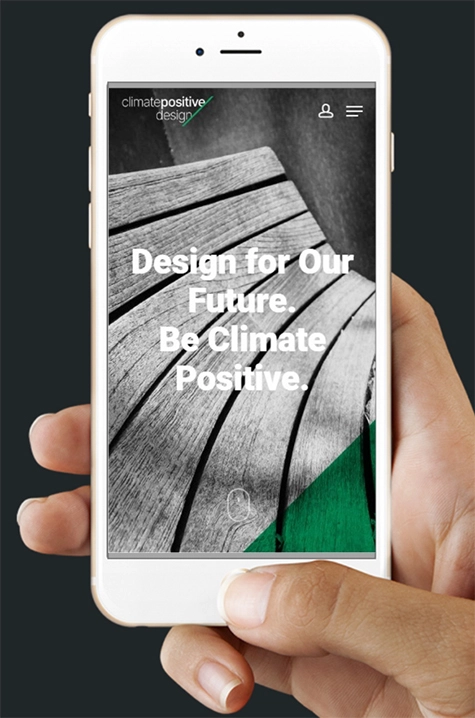
To help landscape architects reach this goal, Pamela Conrad, ASLA, a principal at CMG Landscape Architecture in San Francisco, has created an inventive new platform: Climate Positive Design.
She has also thrown down the gauntlet with a new challenge: if all landscape architects and designers use the approach, they could reduce greenhouse gas emissions in the atmosphere by 1 gigaton by 2050. That would put landscape architecture well within the top 80 solutions found in the Project Drawdown report.
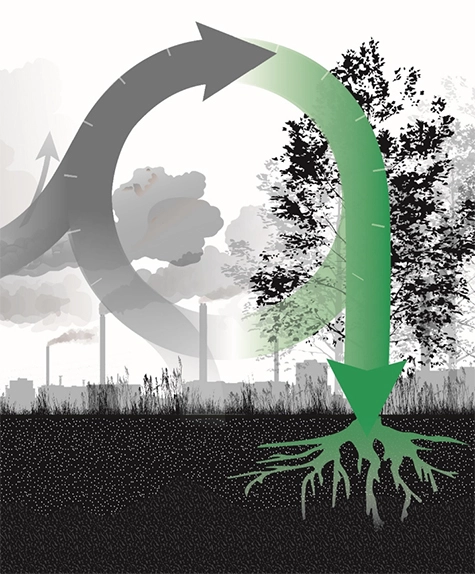
According to Conrad, Climate Positive Design "is not only an opportunity to re-imagine how we design our world from every aspect, but a responsibility.”
Using the site's Pathfinder tool, landscape architects and designers can establish and then ratchet up specific sequestration and emission reduction targets for their own projects. "A target of five years is suggested to offset carbon footprints for greener projects like parks, gardens, campuses, and mixed-use developments. For more urban projects that require a greater amount of hardscape to accommodate programming, twenty years is the targeted offset duration."
Through her research, which includes illustrative and useful case studies produced with CMG, Conrad found that "targets could be met without changing the program or reducing the quality – the projects merely became greener."
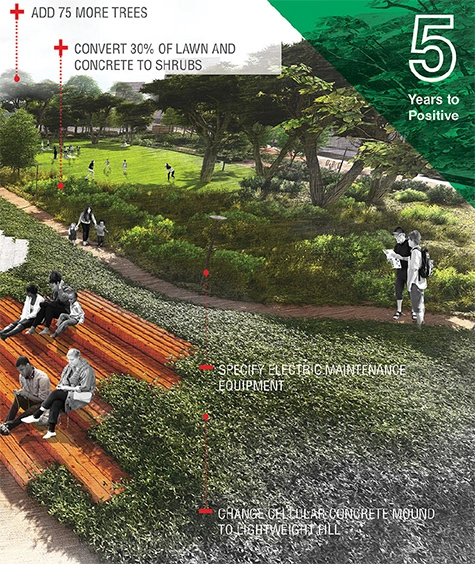
The website offers a design toolkit that not only shows landscape architects how to incorporate more trees and shrubs and preserve carbon in soils, but also how to replace carbon-intensive materials used in pathways, walls, fences, and furnishings with low-carbon alternatives. Conrad makes it easy to find sustainable options.
A few details about the process: Landscape architects or designers who log a project in the app are asked to input the sources of carbon, which could include "approximately eighty different types of materials used in landscape projects such as paving, walls, fences etc. and their associated ‘embodied carbon’ from extraction, manufacturing, transportation, installation, use/maintenance and replacement. The data is derived from the Athena Impact Estimator."
Then designers are asked to add in data about the carbon sinks they are incorporating, which could include: "trees, plants, wetlands and certain types of meadows/lawns capture CO2 from the atmosphere and sink carbon into the soil." Conrad notes that "all data used for calculating sequestration and decomposition for trees and shrubs is obtained from the U.S. Forest Service."
Lastly, landscape architects and designers can add in the "carbon costs," which "represent emissions associated with mowing/pruning performed using machinery and fertilizer use for trees and shrubs. These emissions occur regularly over the lifespan of the project and are often referred to as ‘operational carbon.'"
Once this information is submitted, landscape architects will receive a Climate Positive score that indicates how long it will take to offset the carbon embedded in the project or expended through maintenance operations. The website will then send design recommendations for reducing emissions and increasing sequestration much faster. And each project has a dedicated page that can be re-visited and re-evaluated or shared.

Data collected through the app will be reviewed by advisory partners including the Landscape Architecture Foundation (LAF), American Society of Landscape Architects (ASLA), Canadian Society of Landscape Architects (CSLA), International Federation of Landscape Architects (IFLA), and the Landscape Architecture Canada Foundation (LACF).
Conrad formulated the system during her Landscape Architecture Foundation (LAF) fellowship. It's also the result of years of research and collaboration with Atelier Ten.
Go to Climate Positive Design.
Also, check out ASLA's guide to climate change mitigation and landscape architecture and series of sustainable residential design guides.