

.webp?language=en-US)

.webp?language=en-US)


Advertisement
_HeroImage.webp?language=en-US)
Climate Resilience & Biodiversity
Landscape architects plan and design communities in a manner that mitigates and adapts to a changing climate and addresses the biodiversity crisis. Using their education and experience in science and environmental design, landscape architects plan nature-based infrastructure that reduces weather-related impacts, mitigates ecological harms, and improves public health, safety, and well-being, leading to resilient and economic vibrant communities.
Excess Urban Heat Mitigation Act
-
The American Society of Landscape Architects (ASLA) supports legislation that encourages the use of green infrastructure and nature-based solutions, and other landscape architecture techniques to address extreme weather events.
-
Today, many communities are plagued by extreme heat, which is increasing in frequency, duration, and temperature, affecting public health and air quality, infrastructure maintenance, natural disaster frequency, and more.
“Extreme heat is a growing public health emergency that kills more Americans every year than any other weather-related causes—and breaks down American infrastructure. Senator Ruben Gallego’s Excess Urban Heat Mitigation Act offers a smart, scalable response by supporting proven landscape-based strategies like tree planting, bus and transit shelters, green roofs, and park development. The American Society of Landscape Architects (ASLA) strongly supports this legislation, which affirms the vital role of landscape architects in building healthier, cooler, and fairer communities through design that works with nature,” said ASLA CEO Torey Carter-Conneen.
-
On March 27, 2025, Senators Ruben Gallego (D-AZ) and Ed Markey (D-MA) reintroduced S. 1166, the Excess Urban Heat Mitigation Act. A House version of the bill, H.R. 3703 was reintroduced by Representative Yassamin Ansari (D-AZ) on June 4, 2025.
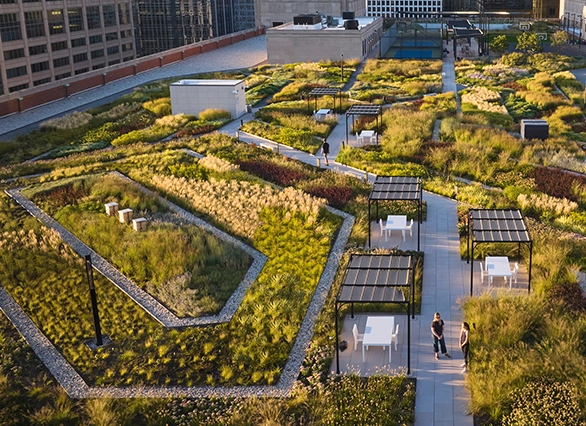
This bill would help bring proven solutions to communities nationwide. Specifically, the measure would establish a grant program to provide communities with access to solutions that help mitigate some of the impacts of climate-induced high temperatures, including green roofs, tree planting, bus and transit shelters, and other cooling techniques.
Additionally, this bill seeks to advance environmental justice initiatives by providing specific consideration for projects in underserved communities. For example, no less than 50 percent of financial assistance under this bill will be provided for projects in low-income and Environmental Justice communities in any fiscal year. -
Senator Ruben Gallego (AZ), and cosponsors.
Representative Yassamin Ansari (AZ), and cosponsors.
Take Action for Excess Urban Heat Mitigation!
Recovering America's Wildlife Act
-
Restoring ecosystems and protecting, conserving, and enhancing biodiversity are essential to all life. Currently, our planet is facing an alarming biodiversity crisis driven by human activities, including habitat fragmentation and degradation and climate change. Landscape architects are uniquely trained to address many of the root causes of the biodiversity crisis. They plan and design habitat connections and corridors, restore degraded ecosystems, and increase biodiversity through the incorporation of native tree and plant species – all of which have significant climate benefits as well.
-
The 2022 World Wildlife Foundation’s Living Planet Report reveals an average decline of 69 percent in species populations since 1970. Further investment is required to slow and then reverse the loss of biodiversity and ecosystems. Habitat loss and fragmentation are major contributors to the biodiversity crisis, and landscape architects are uniquely positioned to take a leadership role in planning and designing nature-based solutions to these challenges.
The U.S. Fish and Wildlife Service has taken steps to help conserve our nation's many species and prevent species from becoming threatened or endangered. The agency funds each state, territory, and the District of Columbia’s federally approved Wildlife Action Plan—science-based blueprints for protecting at-risk wildlife and habitats. The current source of federal funding to implement these plans is the State Wildlife Grants Program, which only provides an estimated $65 million annually for all the states, territories, and the District of Columbia. This amount of funding is not nearly enough to address the biodiversity crisis. It is estimated that about $1.3 billion is needed to implement these plans. -
On March 30, 2023, Senators Martin Heinrich (NM) and Thom Tillis (NC) announced the reintroduction of the Recovering America’s Wildlife Act. Representative Debbie Dingell (MI) is leading the reintroduction of the legislation in the House of Representatives. This measure would safeguard and enhance biodiversity through proactive conservation efforts. The bill will codify and establish a dedicated source of funding for the existing Wildlife Conservation and Restoration Account under the Pittman-Robertson Wildlife Restoration Act for the conservation, restoration, or management of wildlife and plant species of greatest conservation need, including endangered or threatened species, or the habitats of such species.
Specifically, the Recovering America’s Wildlife Act will provide state and territorial wildlife agencies with $1.3 billion in annual funding to implement their Wildlife Action Plans. This measure also invests an additional nearly $100 million annually for the first-ever dedicated source of federal wildlife funding for Tribal Nation conservation efforts. Tribal Nations own or influence an estimated 140 million acres of land that provide habitat for more than 525 threatened and endangered species. These investments would provide opportunities that drastically increase the conservation and protection of more than 17,000 at-risk species of wildlife and wildlife habitats nationwide.
Additionally, the bill requires the federal government to study and report on the progress of conservation methods as well as to annually submit a list of threatened and endangered species for recovery plans. -
To date, this measure has not been introduced in the current 119th Congress (2025-2026).
-
Senator Martin Heinrich (NM), and cosponsors.
-
Senator Martin Heinrich (NM) Press Release: Heinrich, Tillis Introduce Bipartisan Recovering America’s Wildlife Act. March 31, 2023
Senator Martin Heinrich (NM) Press Release: Heinrich, Tillis Announce Growing Bipartisan Support for Recovering America's Wildlife Act. May 9, 2023
Landscape Architecture Solutions to Biodiversity Loss
National Wildlife Federation: Recovering America's Wildlife Act
National Wildlife Federation: Recovering America’s Wildlife Act Toolkit
U.S. Fish and Wildlife Service: The State and Tribal Wildlife Grant Programs. September 2020.
U.S. Geological Survey: State Wildlife Action Plans.
Association of Fish & Wildlife Agencies: State Wildlife Action Plans-Blueprints for Conserving Our Nation's Fish & Wildlife.
Convention on Biological Diversity
International Union for Conservation of Nature: Nature 2030
Climate & Biodiversity Action
Landscape architects plan and design systems to mitigate climate change, address biodiversity loss, and create resilient, thriving communities.