

.webp?language=en-US)

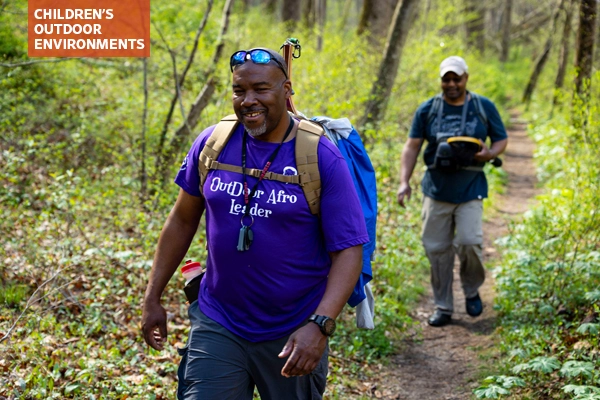
The ASLA Children’s Outdoor Environments Professional Practice Network (PPN) kicked off 2024 with their fourth Zoom Book Club. The PPN was honored to host Rue Mapp, the founder of Outdoor Afro, a non-profit organization that focuses on Black connections and leadership in nature. As the author of Nature Swagger: Stories and Visions of Black Joy in the Outdoors, she writes about her joyful and deep connection with nature starting with her father’s ranch in California at a young age and continuing with a capstone trip to the High Sierras. She recognized a need to reconnect Black people everywhere to the power of nature. This collection of essays and accompanying photography focuses on a sense of Homecoming, Places of Purpose, Hands on the Land, and In the Name of Joy through the specific Black American experience and is a standing invitation to all people of all ages about the joy to be found in nature immersion.
Below we recap the powerful and inspiring conversation, moderated by PPN leader Lisa Casey, ASLA.
The discussion started with a quick introduction to the author. In addition to being Founder and CEO of Outdoor Afro, Rue serves on the governing council of the Wilderness Society, has led a hike with Oprah, been invited to the White House, and is a National Geographic Fellow, among many other recognitions and appearances.
Participating from the Bay Area, Rue read from Nature Swagger’s introduction to provide an overview of her early life, education, current work, and her inspiration for founding Outdoor Afro, followed by Q&A.
Hospitality is a theme in the opening chapter and throughout the book. How has the idea of a standing invitation shaped Outdoor Afro?
Outdoor Afro gets to create a microcosm of that welcoming mentality, all around the country. People can create these types of spaces near and far and share them with others. It’s an extension of what's possible—what was possible in my life and what I hope can be made possible in other's lives through connections through nature.
Nature means a lot of different things to different people. How do you define nature?
So many people think nature is a place you drive to, or that it begins at the trailhead, or on a mountain. But we are nature—we're not separate from the ecosystem; we are impacted by things like the lunar cycle, and we are all made up of water. We are all part of a continuum and are part of nature—we should think of ourselves as nature, and not think of nature as something separate. People may feel a certain community does not have a connection to nature, or may be thinking, how can we get more people connected to nature? But it's better to start with the thought that we are already connected to nature, because we are nature.
During the pandemic, many people were feeling isolated and cut off. It was a time to recalibrate and think about what nature means to us and how we can bring nature into our lives and reexamine our proximity to nature. You are always embodying and carrying nature with you.
You touch on a new narrative in the book and in some of your other interviews. Can you describe what that means to you?
I did not realize how unique my upbringing was (half of my time was in Oakland, CA, and the other half was spent in oak woodlands). I kept being confronted with a narrative that Black people do not do X (don't swim, don't hike, etc.). I decided in the early days of Outdoor Afro that it is important to reset the narrative. My upbringing may have been different from others, but there is a rich history of Black people connecting to nature in an everyday way. I wanted the narrative of Outdoor Afro to stand on the shoulders of that. Nature isn't about dangling off the side of a cliff or being in the back-country—it can be fishing or a family reunion in a park or a neighborhood walk where you notice the changing seasons.
We aim to create a generative, expanded perspective on nature so more people want to opt in. Our core demographic is working, busy families. The idea of nature as a stressful thing that's a four hour drive away—who's going to want to do that?
Black people have always been out of doors. The question of “Why are Black people not connected to nature?” misses the fact that it is a representation and perspective issue. Have you seen a shift since 2009 around the representation of Black people in outdoor environments?
Around 2010, when Sally Jewell was CEO of REI, they had a video ad of a Black couple camping. At that time, the ad was surprising, but since then, a shift has occurred. There are now a bunch of affinity organizations that did not exist when Outdoor Afro started. Now, I can feel what we’ve accomplished. I set out to make this visual representation shift happen, and it has happened. And it's not performative—it's about having the representation not only look like America but it's also about the stories. Storytelling helps people to remember important narratives—for instance, George Washinton Carver as an environmentalist, but also the heroes in their own families: a grandmother who gardened, for example. And it’s not just ‘for the ‘gram’—it’s about deeper remembering.
“Places of Purpose” includes a touching story about kayaking with your older sister on Martha’s Vineyard and opens up a narrative about several Black spaces and havens for recreation that have existed for decades. Talk to us a bit about visiting Martha’s Vineyard and these Black recreational spaces more broadly. Do you think these spaces tie to a bigger narrative?
This was a go-to destination for working class Black people throughout the early 20th century. There are homes that have been owned for generations, and families who have been coming here for generations. Martha’s Vineyard felt welcoming—it did not feel like this place was not for me, and there were not many places like this on the West Coast, which has young cities, and fewer stories and structures that go back generations.
In the middle of the worst times for Black Americans, having a refuge was so important. Black people built these places for themselves, as enclaves for people to recreate even when beaches and ski resorts were segregated—Black places that were oases in nature, with vibrant economies and robust offerings. Black people were early contributors to the outdoor economy as we know it today. My father, coming from the Jim Crow South, decided he was going to create an enclave—this is another part of the history, that can-do spirit, that Outdoor Afro gets to stand on the shoulders of. Over time, these places became less popular, so the narrative became that Black people had less of a connection to nature. History is an important part of story arc and narrative.
“In the Name of Joy” includes a section where you begin Healing Hikes. Can you tell us about that experience?
I asked myself what I should be doing, and the answer came back clearly: "You do nature, Rue—that's your lane." So I gathered local people and took them to the redwoods, my favorite biome in Oakland. We were in a place where there were no police in riot gear, no glass breaking. Some people were feeling confused, hurt, angry. What we had in common, when we went into the redwoods and were enveloped in that setting, was that we were releasing all of our stress, like in the old spiritual, “I'm going to lay down my burden, down by the riverside.” Tapping into the old wisdom of nature, we came out feeling renewed. We have been doing Healing Hikes since 2014. It’s not therapy, but it's a way of reminding people there's a place you can go to meditate, shout, get your feelings worked out. Nature is adept at helping us solve pretty much anything. I am proud of the ways that many Outdoor Afro volunteers have carried on this tradition.
Most of us are landscape architects or students and we think about creating outdoor spaces every single day. Are there any things that you see in the physical environment when accessing nature that make it more or less welcoming?
Initially, in response to this question I thought about signage and interpretation. I am curious about how built things like signs and interpretation are woven into landscape architecture projects. Even if it’s a graphic designer or environmental designer handling the signage, landscape architects can lead the client in creating and adding signs.
For example: in a park, you go to a placard, and it will tell you some history of the park. But a lot of information is not on that placard; you need to do a bit of research to find oral histories and other types of information, but once you know those stories, you feel more connected.
To illustrate this, think about San Francisco’s Sutro Baths: in the late 1800s, John Harris, who worked as a waiter in downtown San Francisco, was denied access, and this was a test case for subsequent civil rights cases in California. Once people knew this story, they felt more connected. A new placard was created about John Harris.
Another thought, and this ties in to making access to nature more welcoming: bathrooms are so important. People who are intimidated by nature, and a top concern is where to go if a bathroom is needed, especially with kids and elders involved. Landscape architects can make access to nature more equitable by designing with needed resources and facilities in mind.
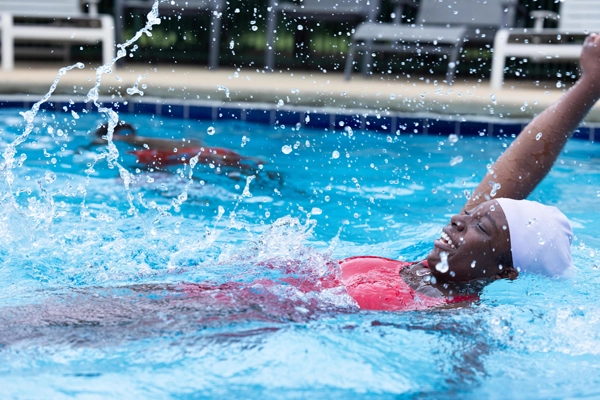
The book includes an essay from ten-year-old Bryson Sutton about learning how to swim. It is so valuable for children to add their own voices to these conversations. Can you tell us more about the inspiration to include Bryson’s words? How are children involved in Outdoor Afro?
Bryson’s mom is a dear friend, and I have known Bryson since he was born. They joined an Outdoor Afro event, and all the kids were swimming except Bryson: he was not part of the activity, and was mad he could not take part. He was a very determined young man. Bryson became student #1 of what is now the Making Waves program. Now, nearly 2,000 young people have learned how to swim through Outdoor Afro. People who know how to swim will care about water conservation and beach cleanups. Swimming can be a gateway drug to the outdoors
How do you define ‘nature swagger’?
Nature swagger is seasonal ease in nature. It’s being able to live in the flow of nature and being able to meet your needs and the needs of others through lived experience in nature. It could mean shopping at your local farmers market, or harvesting your own food. It’s a confident connection to nature that is joyful and generative. And it is hope for Black community and for everyone to live lives filled with nature swagger.
To follow Rue, check out outdoorafro.org, Outdoor Afro on social media, ruemapp.com, and @ruemapp on Instagram.
For recaps of the PPN’s previous Zoom Book Clubs:
- October 2023: Naturally Inclusive: Engaging Children of All Abilities Outdoors by Ruth Wilson, PhD
- May 2023: Schools That Heal: Design with Mental Health in Mind by Claire Latané, FASLA, MLA, SITES AP
- January 2023: Letting Play Bloom: Designing Nature-Based Risky Play for Children by Lolly Tai, PhD, RLA, FASLA