

.webp?language=en-US)



Looking Over the Horizon: Digital Twins and the Future of Landscape Architecture
by Radu Dicher, LFA, ASLA
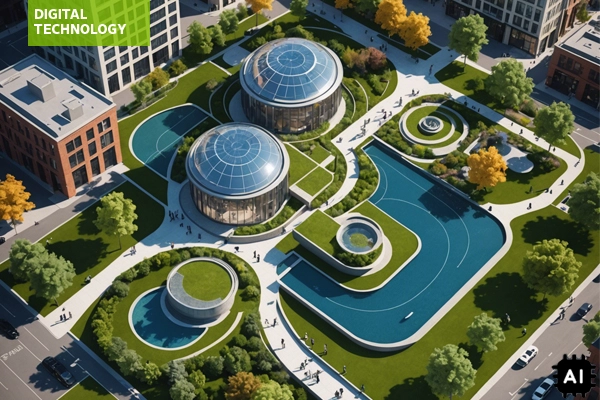
Those of us interested in concepts such as “digital transformation of the designed environment” or just by next generation architecture, engineering, construction, and operations (AECO) paradigms will always look forward to what’s at the far edge of the conceptual or possibly pilot application level.
Certainly, the emergence of AI has taken the industry by storm. But AI is arguably one—deeply transformative, and maybe even radically upturning—part of the data-centric universe that AECO inhabits now. The beginning of this evolution can be tracked in the emergence of BIM, the shifting of projects to the cloud—substantially predating the onset of cloud-based storage and, ultimately, workspace in the mainstream—and other similar shifts and reconfigurations, or sometimes entirely new notions and concepts. Or, as we could call them, paradigmatic shifts.
Such an application that is less talked about—but potentially equally transformative—is the Digital Twin (DT). The Digital Twin Consortium defines it as “a virtual representation of real-world entities and processes, synchronized at a specified frequency and fidelity.” This definition is targeted well beyond just the AECO realm—in fact, AECO is an industry that is lagging behind others (such as manufacturing, the medical industry, automotive, etc.)—but a couple of critical characteristics of the DT are that it is particularly suited for bridging to “real-world entities” (we’re purposefully avoiding terms such as “built,” as those tend to suggest exclusion of items in landscape architecture scope) and account for “processes.”
We posit that these characteristics make the Digital Twin particularly applicable to the field of landscape architecture. Among the AECO disciplines and trades, landscape architecture deals with process, external/natural stimuli, growth, erosion, entropy, and other less disciplined phenomena. With the specific types of items in scope for us, the active feedback loop from site to the digital is essential. It facilitates accounting for evolutions that would otherwise be inconspicuous and both monitoring and responses/adjustments would be difficult, slow, or ineffective.
Let’s find some examples where the Digital Twin would be an appropriate application to use.
- Site monitoring for invasive species encroachment. Let’s imagine a site where there’s a high likelihood species unintended for the site may encroach into, or grow on it. A Digital Twin where the data flow from site would be mediated by drones or site cameras would be able to monitor the plantings on site. Interpreting the raw data from the site could be executed by pattern and chromatic signature recognition using AI in order to determine the presence of invasive species.
- Shoreline erosion monitoring. This would also involve drones or other types of site-located cameras, and would involve continuous monitoring of the morphology and dynamics of the shoreline in contiguity with a site. In effect, AI or other predictive modeling could provide anticipated effects or plots of future configuration, with great capacity to evaluate the effects on the site. It may be possible, in fact, to implement a monitoring solution involving predictive modeling which would then inform the actual design before it is implemented for better decisions and anticipated outcomes from the project lifecycle.
- Irrigation water utilization/needs monitoring and optimized delivery. Sensors on site could continuously assess the moisture level in the soil, the health condition of the plantings, and evaluate optimal water delivery for optimal growth conditions. This DT application could also effectively incorporate another data stream by collecting weather data from online sources and use both of these datasets to make irrigation more efficient and effective. This feedback loop would operate in both actual site data and anticipated weather data, and it could additionally employ predictive models to support future performance of the site and its plantings.
In fact, as we’ve seen in the examples above, AI is a particularly fit addition to the Digital Twin application. This is because AI has an inherent capacity to interpret complex data and offer enhanced and effective processing of it. In fact, some of the applications involving items landscape architecture has in its scope may not be possible without AI.
The AECO industry is historically one of the slowest to adopt new technology, and landscape architecture may even be at the conservative end of the range within AECO. But that’s really more of an opportunity than an impediment—the room available for innovation and the nimbleness available to do it is far greater than in other, more entrenched disciplines.
The Digital Twin field is currently undergoing expansive growth, and there’s an increasing interest in its relevance for the AECO industry. Along these lines, the National Institute of Building Sciences (NIBS), through its Digital Twin Integration Subcommittee, has embarked on working toward a position paper—publication forthcoming—exploring the challenges and opportunities posed by the DT for this field (the undersigned being one of the authors). The considerations made here are extending the broader points made in that paper to be more specific to the field of landscape architecture.
Radu Dicher, LFA, ASLA, has a diverse academic background in both physics and history. He embarked on his career in the AEC industry over 20 years ago as a field engineer for an architectural office in Chicago. After furthering his education by completing graduate MLA hours at IIT in Chicago in 2008, he took a deep dive into MEP BIM Management. In 2020, Radu joined SWA Group in order to establish their BIM infrastructure and embarked on the sustainable adoption of edge technology by the landscape architecture profession nationally and globally through organizations like ASLA, National Institute of Building Sciences (NIBS), and BIMForum. Radu is also co-leader of the BIM Working Group of ASLA's Digital Technology Professional Practice Network (PPN).