

.webp?language=en-US)


by Roger Grant, PLA, ASLA
Any family trip is an opportunity to explore a new playscape, and a recent trip to Unity Park in Greenville, South Carolina, was an eye-opening experience at one of the most ambitious children’s playscapes in the Southeastern US.
The park was designed by MKSK for the City of Greenville, and it opened in May of 2022 with a cost of approximately $80 million. It is considered a milestone in social progress, as it merges a historically underfunded and predominantly African American community park with the adjacent historically white community park. At 60 acres, the park is bisected by the ecologically restored Reedy River, and it has a wide variety of amenities, including a sequence of children’s play areas, lawns, trails, a feature pedestrian bridge, parking, and a large former warehouse building repurposed as a collection of restaurants and office spaces. At the time of my visit, I was not aware I was walking into such a large, complex, and historically significant project. I was simply on a brief visit to experience and take observations of an exciting playscape.
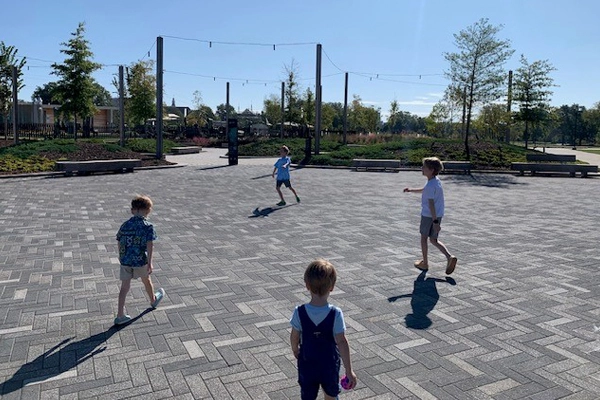
We pulled up to the park on a warm fall morning. The primary relationship of the parking on site is to the restaurant and office complex. A sidewalk provides pedestrian and stroller connectivity from parking to the playscape, but it feels somewhat indirect. We observed most visitors opting to walk through the lot and bus drop-off areas as a shorter and more direct path to the playscape. The bus drop-off is the closest vehicular route to the play area, and it appears to be heavily used by schools. Several busloads of excited children were dropped off during our visit. For green infrastructure designers, the linear bioretention cells running the length of the parking fields are of the highest quality in design and maintenance, featuring dozens of native species of shrubs, perennials, and grasses. My children were more enthused by the prospect of play, so I limited my photos and notes of bioretention plant species, and we hastily made our way to the play areas.
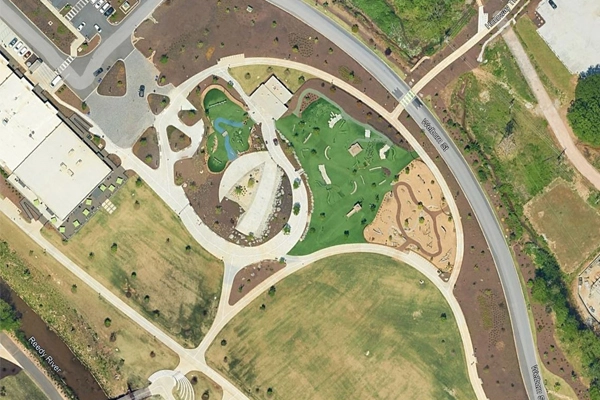
The playscape complex sits on a constructed plateau, making it an impressive and highly visible feature in the landscape. The walk up this hill features large landscape areas and thoughtful monuments recognizing beloved and dedicated members of the community. At the top, the reward for the small hike is revealed as a splash pad, plaza, young children’s playscape, and attractive modern restroom building. As a southerner, I appreciate the effort in building this roughly 20’ high elevated pad for the play areas, as it promotes good air circulation in our hot, humid summers.
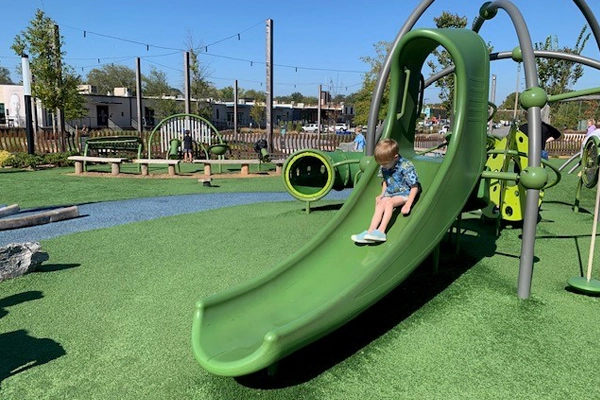
The splash pad is a decorative combination of concrete, flagstone, and boulders as well as seating with shade canopies. The smaller children’s garden has a decorative Cor-Ten steel fence and opens to the splash pad and to the plaza with restrooms. It is clad in synthetic turf in green with accents of blue poured in place rubberized granules, representing a playful imaginary land and water motif. A combination of play features made of black locust beams and traditional powder coated steel and plastic as well as some minor earthen mounding provide the primary source of play, and an enclave within this space contains a set of weatherproof outdoor musical instruments. The entire space is a carefully curated collection that forms a clean, cohesive, and predominantly synthetic playscape.
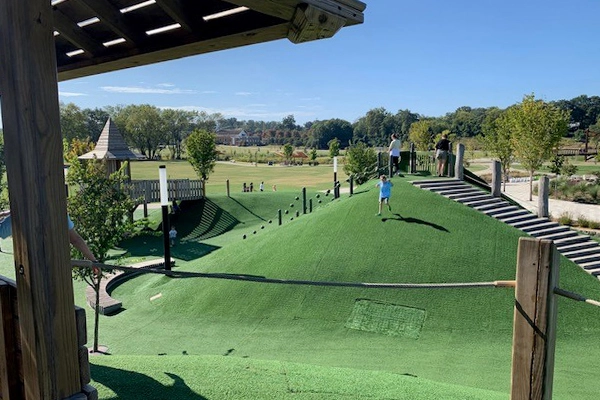
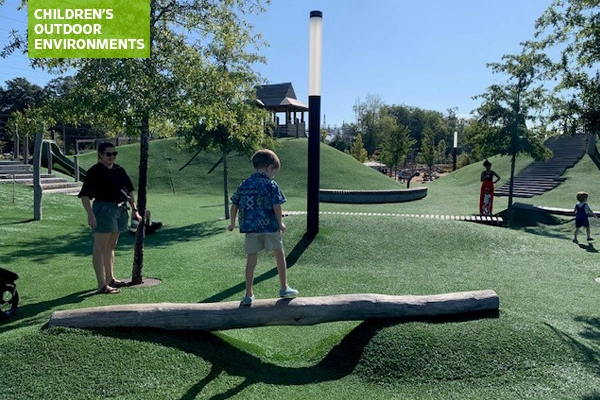
Beyond the small children’s zone was a seemingly unfathomable expanse of synthetic turf clad topography. At over half an acre, this is massive for a turf-play installation that is not laser graded and dedicated to organized sports. These rolling hills of turf create an almost alien surface that resembles a large green skate park. It is punctuated by various slides, black lost beam poles, rope climbers, stairs, benches, and well-crafted wooden clubhouses built by Asheville Playgrounds. As busloads of children arrived, many of them opted to body slide directly down the turf hills rather than using the plastic hillside slides. The space is tremendously open from a visual perspective. This is both liberating in allowing freedom of movement, but it is also limiting, providing few spaces for privacy or seclusion. The lack of shade observed in the splash pad and smaller children’s playscape is even more notable here in the context of synthetic turf, as parents were seen seeking shelter under the shaded enclaves of the playhouses.
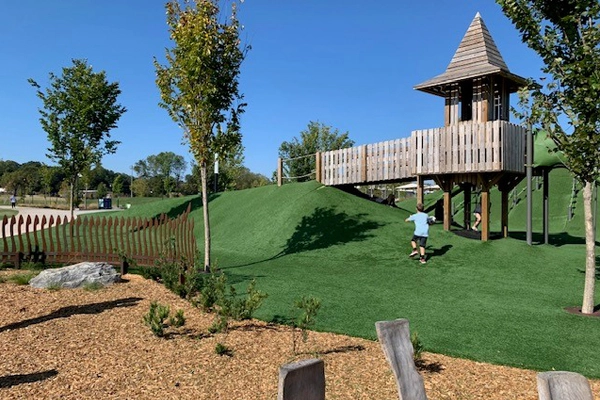
At the edge of the synthetic hillscape was the final act of this playscape complex, featuring natural playground elements. The visual contrast of the engineered wood fiber surfaced natural play area to the synthetic turf is like night and day, however the function of these spaces was remarkably similar. Like the synthetic play area, the nature play area was a collection of well-crafted play pieces, arranged to meet or exceed safety standards for 2–12-year-olds. There is no topographical change in this space, and with very few play-functionally linked elements, it feels like a collection of pasteurized nature play vignettes. This space featured some native planting groupings and unique wooden surfacing trails, but notably it did not contain water, sand, moving parts (other than swings), or other interactive features that would promote creative play, privacy, a sense of calm, or a connection to nature.
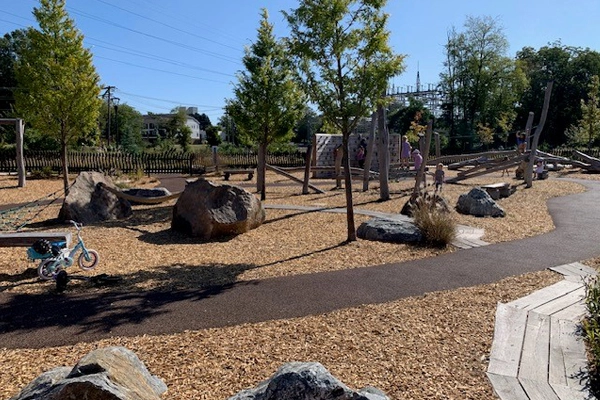
The Unity Park playscape was a unique experience. It is one of the largest and most ambitious playscapes in the Southeastern US, featuring distinct experiential areas and remarkably photogenic rolling hills of synthetic turf. While it meets all relevant safety requirements, the relatively static play features have a low degree of challenge for most children I observed. Additionally, there are few opportunities for tactile manipulation of the landscape that might foster interactive play, creative play, and growth. While it contains “natural playground” elements (as verified by the stainless-steel tags on each carefully treated tree component), it seems at odds with the experiential values of active free play outdoors and nature play as espoused by authors such as Angela Hanscom in Balanced and Barefoot and Susan Solomon in The Science of Play. Many features were rigid and predictable, which sets a troublesome trajectory for repeat visitors whose incentives diminish as they conquer all constructed obstacles. Despite these shortcomings, the topography itself provides a great deal of entertainment. Observing children attempt various routes down the manufactured turf hill was reminiscent of my holy grail of creative playground endeavors—the concrete slide at Koret Children's Playground at Golden Gate Park in San Francisco.
Playgrounds are an opportunity to bridge the gap between the more protected and sterile indoor environments and the raw natural world. Exposure to the elements (air, wind) is given, but contact with soil, plants, and wildlife could have a profoundly positive impact on developing children. Sterilized outdoor play environments are proliferating in part due to funding mechanisms, cultural values, and legal liability. Unity Park is a landmark achievement for the City of Greenville, South Carolina. The playscape provides a unique and invaluable case study for future playground design in the field of landscape architecture.
Roger Grant, PLA, ASLA, is a landscape architect and consulting arborist in the sprawling North Atlanta suburbs. He has been practicing for 18 years, working on a wide variety of public and private developments. A father of four, he is passionate about the design and function of children’s outdoor spaces and cognizant of the need for creative and engaging playscapes that can compete with modern devices for children’s attention and entertainment. Roger is co-chair of ASLA’s Children’s Outdoor Environments Professional Practice Network (PPN).