

.webp?language=en-US)


Community Groups Going Green in Response to Climate Change
by Arnaldo D. Cardona, ASLA
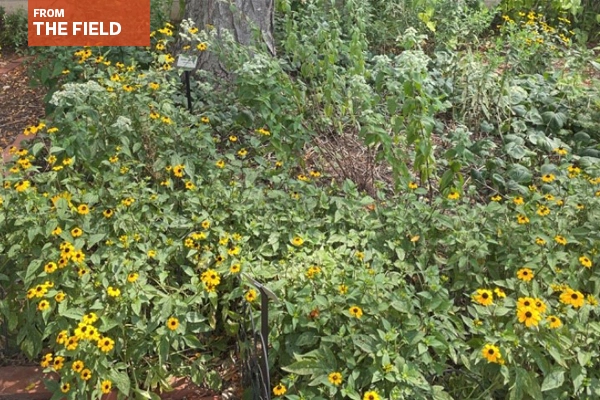
To promote community awareness of our profession, I have been assisting a church in Richmond, Virginia, in a landscape restoration project. Susan Boze, a church member, invited me to a committee meeting where, to my surprise, I heard terms like landscape restoration, use of native plants, invasive plant control, and climate change. I was excited to hear non-landscape architects talking about these topics with such passion and interest. The group was right on point on these environmental issues, and I shared how all the issues being discussed were closely related to the landscape architecture profession. I suggested they share their activities with the local ASLA Virginia Chapter and as a member, I would support this group’s goal of educating the community by sharing the initiatives that ASLA is diligently promoting.
So, who was this well-informed group? According to Committee Chair Kristine Montamat:
"The Habitat Restoration Group is connected to the Creation Care Committee of the Episcopal Diocese of Virginia. They are all volunteers that started meeting monthly in May 2023. Their focus is to restore the land around our churches, applying the same ideals from local homes and the community. Their members are composed of Master Gardeners (Virginia Tech Extension), Master Naturalists, an Audubon Ambassador, landscape designers, an engineer, and lifelong learners pursuing horticultural knowledge. We are dedicated to learning, spreading awareness, and digging--doing everything we can, with love, to protect the beautiful and essential gifts of nature for future generations."
Ms. Montamat also shared that “our churches have installed rain gardens, native plant gardens, Monarch butterfly stations, pollinator gardens, wildlife sanctuaries, and meditation trails. We have battled (and are battling) a long list of invasive plants—and we sometimes run into opposition when the invader is a ‘traditional' landscaping species like English Ivy.”
Ms. Montamat is a social worker by training and a natives-only gardener:
“I am in the process of converting my 1/3 acre property to a ‘homegrown national park’ in which I will use only native plants in its design. As explained by some of the group members, biodiversity is plummeting, with unknown but potentially scary consequences. The Habitat Restoration Group focuses on how we can transform our properties so that our children and grandchildren can experience the thriving world God gave us. As you know, there is tremendous pressure on land—shopping malls, corporate campuses, sprawling and low-density housing developments, more roads. On the other side of the equation, there's something like 40 million acres of ‘lawn' in this country. It's our nation's largest irrigated crop. It serves no biological purpose, and yet we waste astonishing amounts of water, chemicals, and gas on it.”
To share these ideas with the community, the Creation Care Committee is coordinating an Environmental Ministry Conference entitled, "To Love, Heal, and Bless Creation" on February 17, 2024, in Alexandria, Virginia. The Committee is partnering with students at the Virginia Theological Seminary, Cultivate VTS (an environmental group), and the Justice and Reconciliation Society. The conference is practice-oriented, with workshops on sustainable gardening/landscaping and energy efficiency solutions for church buildings. Next on the calendar is coordinating an activity for Earth Day 2024 on April 22. To learn more, contact Kristine Montamat, chair of the Creation Care Committee, at [email protected]. You may also visit the Creation Care Habitat Restoration (Episcopal Diocese of Virginia) Facebook page and the Habitat Restoration Group Facebook Group, managed by Elaine Sevy.
Nancy Brooks, Extension Master Gardener from the Habitat Restoration Group, highlighted how this group supports sustainable landscaping and shared information about the public education classes offered by the Master Gardeners of Northern Virginia and also about their Youth Education Program in which gardening and nutrition education programs are provided.
As part of the Environmental Ministry Conference, I was glad to assist on a display of a landscape restoration project that a church in Richmond, Virginia, is planning called the Creation Garden Project. It will enhance an existing rain garden and add a gravel pathway to connect a native plant garden with a pollinator garden. The purpose of this garden is to provide food and shelter to bees, butterflies, birds, and other wildlife.
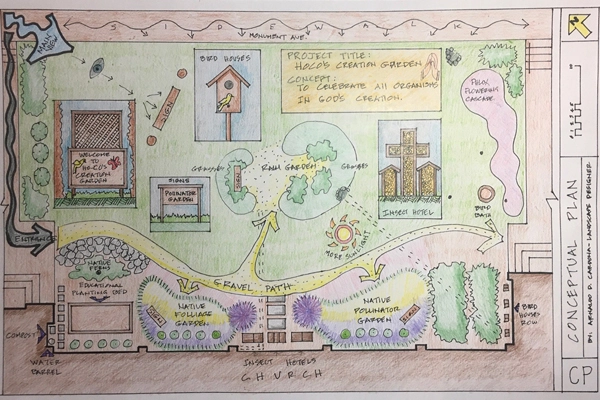
God’s creation for a church in Richmond, Virginia. Click here to view at a larger scale. / image: Arnaldo D. Cardona
After learning about these groups in Virginia and discovering all the issues that community members are working on, I shared this knowledge with my fellow ASLA members, so we understand the importance of networking with community groups to gain more visibility in the promotion of issues like landscape restoration, environmental enhancement, and climate action, among others. Besides schools, we need to realize that approaching civic and religious groups in our communities will help achieve the goals of our profession.
Arnaldo D. Cardona, ASLA, is a retired landscape architect and educator, and has served on ASLA’s Committee on Education. Arnaldo is the author of K-12 Landscape Architecture Education; you can find it among ASLA’s Books by ASLA Members. Proceeds go to ASLA's education programs.