

.webp?language=en-US)

Planting Design for Children’s Spaces – An Interview with site Horticulture Director Mark Jirik
by Wanting Zhang, Student ASLA, and Yiwei Huang, Ph.D., SITES AP, ASLA
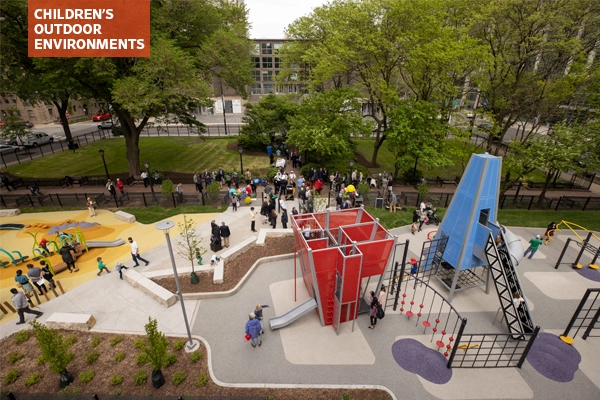
Interviewee: Mark Jirik, PLA, ASLA, LEED AP, Certified Arborist Interviewers: Wanting Zhang, Student ASLA, and Yiwei Huang, Ph.D., SITES AP, ASLA
We recently had a special opportunity to speak with Mark Jirik (M.J.), the Director of Horticulture at site design group, ltd. (site), who provided a lecture to our undergraduate class in Landscape Architecture at Purdue University. This article compiles key insights from his talk and additional reflections he shared with us afterwards. This interview article aims to bridge a gap between theory and practice, providing young designers with an invaluable perspective on designing children’s outdoor environments, especially with planting design, in the Midwest region.
What projects have site worked on previously related to children's outdoor environments?
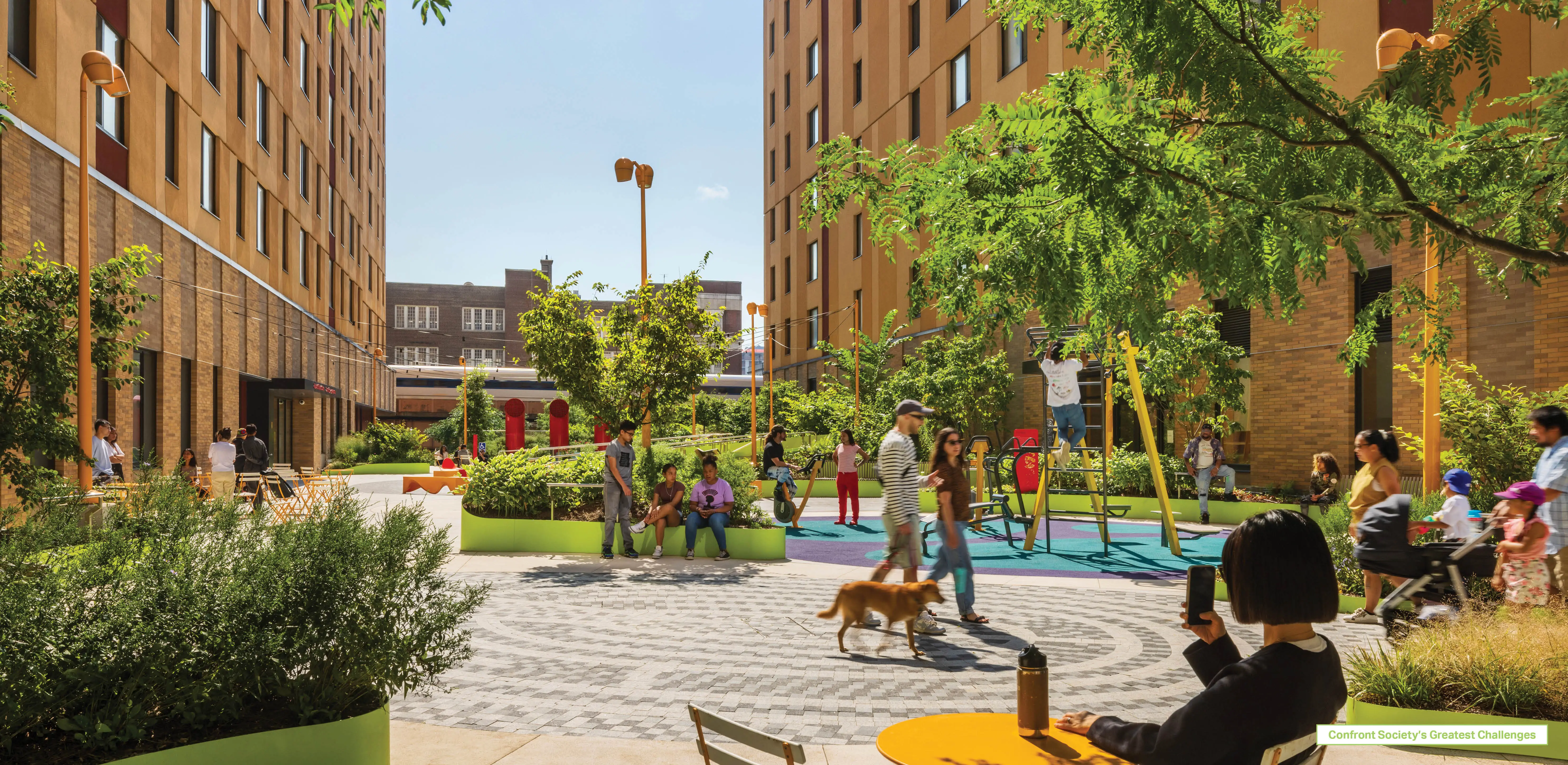
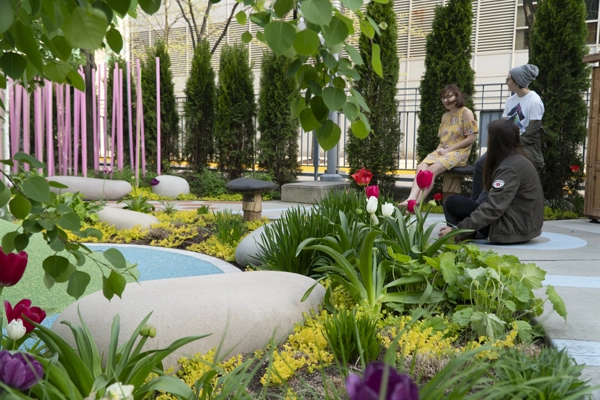
M.J.: site has worked on a wide range of park and playground designs for various age groups. A couple of completed projects that come to mind include Seneca Park (2021) located Near North Chicago and the Comer Children’s Hospital Play Garden (2018), also located in Chicago. Seneca Park hosts two playgrounds, one for children ages 2-5 and another for children ages 5-12. Both playgrounds reference the local dune landscape and nearby Chicago landmarks with a variety of both more traditional and creative play opportunities. Comer Children’s Hospital Play Garden, winner of the 2019 ILASLA Honor Award, provides a place of refuge and healing for hospital patients from and is designed to accommodate and be enjoyed by children of all physical abilities.
In these two design processes, and knowing you are the main horticulture specialist, we would like to know what you think are the points that need attention in designing children's outdoor spaces from a planting design perspective.
M.J.: I grew up in Oak Park, Illinois, not far from Frank Lloyd Wright’s Home and Studio, so perhaps I use his quote too often but relating to planting design, I align with “Form and function are one.” It’s also akin to ‘right tree, right place.’ An often-made mistake, particularly by younger designers, is to select plants on aesthetics alone without consideration of their cultural requirements and how that relates back to the site and its users. With any planting design, we start at site analysis and inventory. This includes careful study of the on-site vegetation and soils, site circulation, site drainage, sun vs. shade, etc. It also involves familiarizing yourself with the client team and anticipated user groups to understand the budget, maintenance, volume of use, desired aesthetics and elements, and so on. Public health, safety, and welfare are other important considerations early on when thinking about plant selections and layouts, like maintaining open view corridors. In all of this, the intent is to better understand the planting-related constraints and opportunities so you can start to craft the appropriate plant palette. Then comes the fun part.
As you have mentioned the importance of site analysis and safety, what are some tips for young designers when considering children's safety?
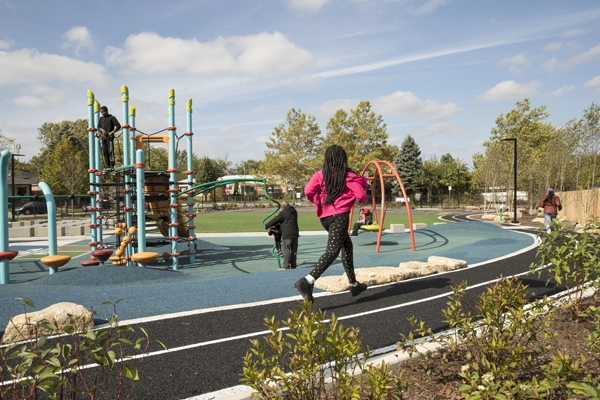
M.J.: Don’t skimp on the site inventory and analysis process and think about safety from a larger, holistic design perspective. Consider site circulation and traffic, sight lines and sight triangles, potential hazards in all seasons, and try to imagine and plan for the most rambunctious child in the space without over-sterilizing it. Then, when it comes to plants, understanding the potential pitfalls or hazards of each is important. Obvious examples include avoiding plant selections around playgrounds that are highly poisonous, like Jimsonweed, or have dangerous features, such as hawthorns with needle-like thorns that can grow to be six inches or longer. They are inappropriate, unsafe plants to site in close vicinity to playgrounds.
Since you have worked on and have seen multiple sites focusing on planting selection, what are some frameworks that students and young designers can use to select plants?
M.J.: Functional traits for plant species in playground design include general toughness and cultural adaptability, hardiness and longevity, drought tolerance, salt tolerance, and multi-seasonal interest. They are all great traits to consider when designing for tough spots, and a playground is a great example. Another recommendation is keeping your toughest, trample-resistant species towards the inside edges of the most trafficked areas in the playground. For form, and when the project is appropriate, I like incorporating bright and unique flora and foliage, contrasting textures, shapes, sizes, etc. But again, “Form and function are one.”
For plant selection, I like a top-down planting approach that begins with the structural layer: canopy trees, understory trees, and large shrubs. They form the multi-seasonal structure and the main architecture of any garden space. They are also often the toughest plant types in a playground setting. Next would be the seasonal layer, primarily composed of ornamental grasses and perennials. Last is the base layer, which includes the groundcovers, bulbs, and mulch. This last layer is often the most sensitive to trampling and thus needs to be carefully sited and/or protected. Based on the project and/or site constraints, it may not be prudent to use all the layers in tandem.
With the Comer Children’s Hospital Play Garden, trampling was less of a concern since use is limited to small groups of children and caregivers. We found there were far fewer planting-related constraints than we often deal with on playground projects. We were also fortunate to engage with the landscape maintenance contractor during planting design. This back-and-forth helped inform the plant selection and layout and allowed us to expand the plant palette into some more unique selections to help blur playground and garden into one. This was particularly true of the willow tunnel and more whimsical topiaries. The planting approach includes areas of block-style planting and others with matrix-style planting. Without knowing that the garden space was to be as well-maintained and cared for, we likely would have favored only the simpler block-style planting. It is easier to maintain than block-style, but matrix-style can add more flair and more of a naturalistic, wild feel. So, another Frank Lloyd Wright quote: “Less is more only when more is too much.” More plant types and species diversity helped craft a more imaginative place of refuge, healing, and enjoyment for children and their families.
Based on previous projects, are there any species you would encourage young designers in the Midwest to use?
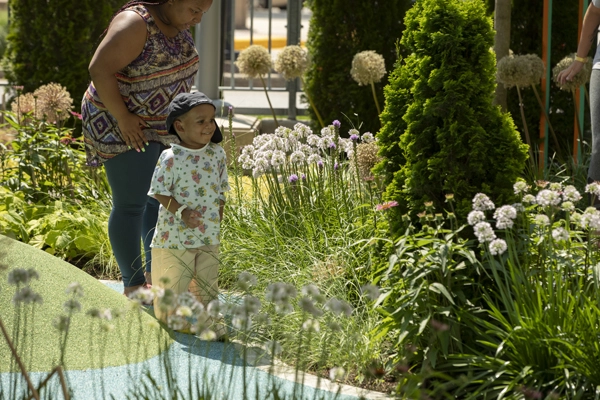
M.J.: I always encourage using bulbs when appropriate for the project and if budget allows. Here in the Midwest, we have a lot of native, tough warm-season grasses and forbs that we love to use regularly but they don’t fully pop into full effect until mid- or late summer. Bulbs help fill those gap times with color and big impact and can set the project planting design apart from others. At the Comer Children’s Hospital Play Garden we utilized several different types of alliums and tulips to help add vibrant colors and warmth.
Knowing your toughest, most adaptable, and utilitarian plants is key for projects where there will be high traffic, limited budget, limited maintenance, and/or any other combination. Liriope might be a good example of a very tough Midwestern groundcover that can spread via rhizomes and create a kind of semi-evergreen carpet to suppress weed growth and help lower maintenance needs. Gro-low sumac is another example, and commonly seen growing in many parking lot islands for good reason. It survives in extremely tough conditions where not a lot of other plants can do well. Kentucky coffee tree and thornless honey locust are in a similar vein and easily two of toughest trees here in Chicago, also making them good selections for more challenging playground sites.
Thank you for imparting such valuable insights. Are there specific resources or practices you'd recommend for budding designers to ensure their project's success?
M.J.: When it comes to teaching landscape architecture, there’s a James Corner, FASLA, quote I hold dear: “best readings of landscape architecture are the specific works themselves.” I strongly encourage emerging designers to explore nurseries, wholesale centers, and study other playground projects firsthand.
Mark Jirik, PLA, ASLA, LEED AP, is the Director of Horticulture at site design group, ltd. As a generalist and landscape architect, his experience covers a wide range of project types and sizes, including master plans, parks, schools, natural areas, and streetscapes. As a specialist and arborist, his expertise lies in arboriculture and horticulture.
Wanting Zhang, Student ASLA, is a master's student at Purdue. She is driven by her interest in harmonizing landscape architecture with educational spaces. Her work explores the innovative integration of edible forests in urban schoolyards, reflecting her commitment to enhancing educational environments through thoughtful landscape design.
Yiwei Huang, Ph.D., SITES AP, ASLA, is an Assistant Professor of Landscape Architecture at Purdue University. Her research focuses on the relationships between people and the outdoor environment, with a special emphasis on addressing the needs of underrepresented groups including children, women, and immigrants.