Professional Practice
Sustainable Residential Design: Using Low-Impact Materials
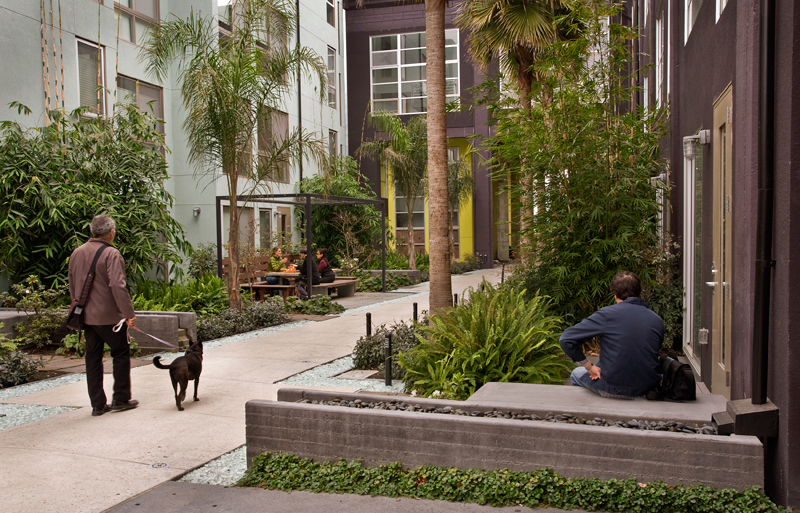 The landscape architect mined elements from the cannery structure, including abandoned machinery, for repurposing in the new gardens. The recycled tumbled glass riverbed in the Dining Room Court, and stone columns in the Lew Hing Garden add to the historic character. Hand crafted site furnishings made from FSC-certified wood, concrete, steel, and glass were designed by the landscape architect and crafted by Miller Company Landscape Architects’ in-house installation team. ASLA 2010 Professional Residential Design Honor Award. Pacific Cannery Lofts / Miller Company Landscape Architects
 New and non-recyclable materials used in homes and landscapes are often not designed to be recycled. These materials can consume enormous amounts of resources to produce and distribute and create additional waste when they are demolished. Waste materials create waste landscapes: landfills, massive incinerator systems, and multi-square-mile floating plastic garbage islands in the world's oceans.
To avoid sending useful materials to landfills and cut down on materials that release toxic substances, The Sustainable SITES Initiative™ (SITES®) recommends reusing or recycling existing materials.
Homeowners can also specify local materials to support local economies and cut down on the energy use from the transportation of materials.
But beyond reused, recycled, or local materials, there are other important ways to reduce the impact of materials on our health and environments.
Sustainable residential landscape design can increase the health of environment through the use of innovative low-impact materials that are permeable and reflective (high albedo).
Permeable materials allow water to infiltrate and recharge aquifers, instead of being sent to combined stormwater and sewer systems.
Reflective, "cool," or white materials help reduce air temperatures, particularly in cities dealing with the challenges of the urban heat island effect, and energy costs by minimizing the use of air conditioning to cool buildings.
There are also more sustainable wood and concrete options out there that minimize consumption of newer materials.
SITES recommends building with certified, sustainably-harvested woods, recycled woods, and recycled plastic or composite lumber to preserve forests, which are critical to sequestering greenhouse gas (GHG) emissions.
To avoid sending useful materials to the landfill, conserve natural resources, and reduce a project’s carbon footprint, SITES recommends landscape architects source sustainable concrete from manufacturers using supplementary cementing materials, like fly ash – a byproduct of coal-fired power plants. Landscape architects should reuse concrete from structures on the existing site, like crushed concrete as an aggregate base. Concrete that incorporates recycled materials, like crushed glass or wood chips, are a more sustainable and use less cement than traditional pavers.
Used in both landscapes and buildings, low-impact materials can reduce GHG emissions and create a healthier environment.
Local governments can partner with non-profit organizations and landscape architects and designers to increase public awareness about why it's important to use low-impact materials.
Permeable Surfaces
Reflective Materials
Sustainable Woods
Sustainable Concrete
This guide was written by Dana Davidsen and Jared Green.
Climate Change Resources:
Download Report:
Sustainable Planning and Design Guides:
Sustainable Residential Design Resource Guides:
Health and Well-Being:
Organizations
Green Seal
Scientific Certification System
The Sustainable SITES Initiative™ (SITES®)
U.S. Green Building Council
Reuse Alliance
Global Reporting Initiative
GreenBlue
MBDC, Cradle to Cradle Certification
Center for Built Environment, University of California, Berkeley
Resources
Sustainable Landscape Materials and Practices, University of Delaware Botanic Gardens
Materials, Global Reporting Initiative Standards
Materials Management, Sustainable Cities Institute
Strategies for Waste Reduction of Construction and Demolition Debris from Buildings, Environmental Protection Agency
Building a Park Out of Waste, American Society of Landscape Architects
Top 5 Eco-Friendly Building Materials, Smart Cities Dive
Research
"The Innovative Use of Materials in Architecture and Landscape Architecture: History, Theory and Performance,” Caren Yglesias, McFarland, 2014
"Cradle to Cradle: Remaking the Way We Make Things," William McDonough, Honorary ASLA, and Michael Braungart. North Point Press, 2002
“The Upcycle: Beyond Sustainability – Designing for Abundance,” William McDonough, Honorary ASLA. North Point Press, 2013
"Green from the Ground Up: Sustainable, Healthy, and Energy-Efficient Home Construction (Builder’s Guide)," David Johnston and Scott Gibson. Tauton, 2008
"Materials for Sustainable Sites: A Complete Guide to the Evaluation, Selection, and Use of Sustainable Construction Materials," Meg Calkins, ASLA. Wiley, 2008
“Sustainable Landscape Construction,” J. William Thompson and Kim Sorvig, Island Press, 2007
“Sustainable Landscape Construction, Third Edition: A Guide to Green Building Outdoors,” Kim Sorvig & William Thompson, Island Press, 2018
“Low Impact Living: A Field Guide to Ecological, Affordable Community Building,” Paul Chatterton, Routledge, 2014
Government Resources
Green Home Case Study: Studio 24, City of Seattle
Landscape Materials, City of Seattle
Green Building Tax Credit, State of New York
PlaNYC 2030, City of New York
Street Design Materials, New York Department of Transportation
Zero Waste, City of New York
Sustainable Building Ordinance, City of Atlanta
Sustainable (Green) Building: Green Building Materials, Integrated Waste Management Board, State of California
Environmentally Preferable Purchasing Policy, City of Berkeley, California
Green Spending: A Case Study of Massachusetts’ Environmental Purchasing Program, Environmental Protection Agency
Construction & Demolition Recycling, City of Oakland, California
Directories
Green Point Rated
McGraw-Hill Construction Sweets Network Sustainable Product Directories, Integrated Waste Management Board, State of California
Projects
Beach House, Amagansett, New York
Dirtworks, PC Landscape Architecture, New York, New York
Curran House, San Francisco, California
Andrea Cochran Landscape Architecture, San Francisco, California
Stone Meadow, Martha's Vineyard, Massachusetts
Stephen Stimson Associates, Falmouth, Massachusetts
Mill Creek Ranch, Vanderpool, Texas
Ten Eyck Landscape Architects Inc.
Le Petit Chalet, Southwest Harbor, Maine
Matthew Cunningham Landscape Design LLC
Sonoma Retreat, Sonoma California
Aidlin Darling
Quaker Smith Point Residence, Burlington, Vermont
H. Keith Wagner Partnership
If you know of useful resources we've missed, please send your recommendations to: info@asla.org