|
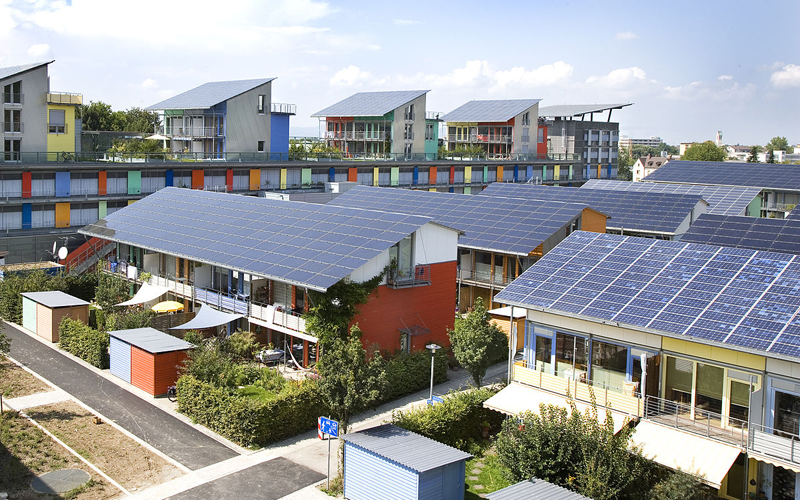
| High Point, Seattle, Washington. Mithun. Juan Hernandez / Mithun |
Inefficient home energy use is not only costly, but also contributes to the growth of greenhouse gas (GHG) emissions, the major cause of climate change. Residential and commercial buildings use ten percent of U.S. energy. According to Architecture 2030, building construction and operations-related energy use accounts for almost 50 percent of total GHG emissions.
Through "integrated site design," a comprehensive approach to sustainable building and site design, sustainable residential landscape architecture practices can not only improve the environment, but also increase energy efficiency. If part of a broader integrated site design, sustainable residential landscape architecture can dramatically reduce energy costs over the long term while creating a healthy residential environment.
Integrated site design is a framework for increasing the quality of the built environment, and involves maximizing existing natural systems to minimize energy usage. These types of designs leverage the many benefits of natural systems, thereby significantly cutting down external energy use. Decreased energy usage also means homes are more resilient to shifts in the availability of energy and climate change.
Homeowners can use sustainable landscape architecture practice to reduce energy usage. As an example, residential green roof systems, which are often key features of integrated site design projects, can significantly reduce home heating and cooling costs. The energy efficiency benefits of sustainable landscape architecture practices, including age-old practices like tree siting for shading, can be further leveraged through the use of clean energy technologies, like solar power. Additionally, sustainable residential landscape architecture practices help reduce the rate of GHG emission growth. These types of sustainable residential solutions, if scaled up, can mitigate residential building and transportation-related emissions.
State and local governments are working with design professionals to incorporate sustainable residential landscape architecture practices into homes throughout urban, suburban and rural areas.
Other Resource Guides in this Series:
|
|
|
Sustainable Design Resource Guides:
|
Sustainability Toolkit:
|
Organizations
Low Impact Development Center
Sustainable Sites Initiative
LEED for Homes, U.S. Green Building Council
Resources
Adapting to Global Warming: A Guidebook, King County, Washington
Introduction to Residential Green Building in New England, U.S. Environmental Protection Agency
"Innovations in Sustainable Site Technology," The Dirt Blog, American Society of Landscape Architects (ASLA)
Low Impact Development Design Strategies: An Integrated Design Approach, Department of Environmental Resources, Prince George's County, Maryland
Low Impact Development Manual for Michigan, Southeast Michigan Council of Governments
Low Impact Development: Technical Guidance Manual for Puget Sound, Puget Sound Action Team and Washington State University
"NYC's Greener, Greater Buildings Plan" for Reducing Building CO2 Emissions," The Dirt Blog, American Society of Landscape Architects (ASLA)
"Solar Decathalon 2009 Innovations: Integrated Site Design," The Dirt Blog, American Society of Landscape Architects (ASLA)
Sustainable Gardening. Recycle Works: A program of San Mateo County, California
Weatherization Guide for Older and Historic Buildings, National Trust for Historic Preservation
Research
"Living Systems: Innovative Materials and Technologies for Landscape Architecture," Liat Margolis & Alexander Robinson, Birkhauser Basel, 2007
"Sustainable Landscape Construction: A Guide to Green Building Outdoors," J. William Thompson & Kim Sorvig, Island Press, 2007
Projects
High Point, Seattle, Washington
Mithun
One Drop at a Time – New Resourceful Paradigms at 168 Elm Ave, Elmhurst, IL
de la fleur LLC
Residential Green Roofs
Green roofs are energy-efficient vegetated roof systems. Once installed, they often last longer than conventional roofs. While the energy saving benefits of commercial green roofs are already well known, residential green roofs can also dramatically improve building energy efficiency. Green roofs regulate buildings' internal temperature and reduce building heating and cooling costs.
Green roofs also function as more sustainable, decentralized stormwater management systems. Green roofs can reduce stormwater run-off, and decrease the energy costs associated with extending and upgrading centralized (and costly) stormwater management systems.
Green roofs benefits include:
- Cost-efficiency: A University of Michigan study showed that more than 50 percent of the cost associated with installing a green roof will be returned in the form of lower maintenance and reduced energy usage over the lifetime of the green roof system.“Nearly two-thirds of these savings would come from reduced energy needs for the building with the green roof.”
- Energy savings: A typical 2-3 story building could experience 15-25 percent savings in summertime energy costs.
- Lower air temperatures: A modeling study found that adding green roofs to 50 percent of the available surfaces in downtown Toronto would cool the entire city by 0.2 to 1.4°F (0.1 to 0.8°C).
- More efficient stormwater management: Green roofs can catch 40-60 percent of stormwater, reducing flow into a city’s sewers
- Lower long-term maintenance costs: Green roofs can extend a roof’s lifespan by two or three times. According to Sustainable South Bronx, a non-profit organization, on a 90 degree day a green roof is about 80°F, while a black roof is 175°F. The higher temperatures cause substantial wear and tear.
Sources: “Reducing Urban Heat Islands: Compendium of Strategies, Green Roofs,” U.S. Environmental Protection Agency and Sustainable South Bronx.
Organizations
Centre for Architectural Ecology, British Columbia Institute of Technology
Center for Green Roof Research, Pennsylvania State University
Green Roofs for Healthy Cities
International Green Roof Association
Lady Bird Johnson Wildflower Center / Green Roof Resources
Living Roofs (United Kingdom)
Resources
Ecoroof Q&A, Environmental Services, City of Portland, Oregon
Green Roofs Benefits, Green Roofs for Healthy Cities
Green Roofs – Cooling Los Angeles: A Resource Guide, Environmental Affairs Department, City of Los Angeles, California
Green Roof Research Program, Department of Horticulture, Michigan State University
Green Roofs Sequester CO2, The Dirt Blog, American Society of Landscape Architects (ASLA)
Green Roof Tax Credits, ASLA Advocacy
Residential Buildings: Roofs, U.S. Department of Energy
What is a Green Roof ?, How Stuff Works.com
Research
"Living Architecture Monitor," Green Roof for Healthy Cities, 2008
"Green Roof Plants: A Resource and Planting Guide," Edmund C. & Lucie L. Snodgrass, Timber Press, 2006
"Green Roof Systems: A Guide to the Planning, Design, and Construction of Building Over Structure," Susan Weiler & Katrin Scholz-Barth, Wiley, 2005
"Roof Gardens: History, Design, and Construction," Theodore H. Osmundson, W. W. Norton & Co. 1997
Government Resources
City of Toronto Green Roof Bylaw, Toronto, Canada
Green Roof and Cool Roof Grant Program, City of Chicago, Illinois, United States
Illinois Energy Plan: Green Roof Program, State of Illinois
The London Plan: Living Roofs and Walls, City of London
"Tax Credits for Green Roofs in NYC," Environmental Leader, June 29, 2008.
Projects
Big Sur, Big Sur, California
Fred Ballerini
Feldman Residence, Santa Lucia Preserve, Carmel, California
Blasen Landscape Architecture
The Louisa, Portland, Oregon
Walker Macy Landscape Architects
Macallen Building Condominiums, Boston, Massachusetts
Landworks Studio, Inc
North Beach Place, San Francisco, California
PGA Design, Inc
Tables of Water, Lake Washington, Washington
Charles Anderson Landscape Architecture, Seattle, Washington
Woody Creek Garden, Pitkin County, Colorado
Design Workshop, Inc., Aspen, Colorado
Residential Green Walls
Like green roofs, green walls, also called vertical gardens, are vegetated walls that can be used indoors or outdoors. Green walls can increase energy efficiency, reduce indoor and outdoor temperatures, and improve air quality.
Green walls can be designed for a variety of plant types, including herbs or succulents, and can be placed in either sun or shade. Edible herb or vegetable walls provide food sources. However, climate and humidity should be considered when installing green walls.
Green walls include most of the benefits of green roofs, but also include:
- Cost-efficiency: Through shading, green walls can lower temperatures in summer and reduce energy costs by 23 percent.
- Reduced air temperatures: Temperatures behind green walls can be reduced by as much as 10 degree celsius.
- Reduced Noise Pollution: Green walls can help reduce sound reflection
Sources: “Living Walls: A Way to Green the Environment” Susan Loh, Australian Council of Built Environment Design Professionals, August 2008
Organizations
Centre for Architectural Ecology, British Columbia Institute of Technology
National Gardening Association
Vertical Farm
Resources
"How to make a Green Wall," Green Living, Love to Know.com
"Inspiring Vertical Gardens for Small Spaces," Bridgette Meinhold, Low Impact Living, 2009
"Introduction to Green Walls Technology, Benefits & Design," Greenroof for Healthy Cities, September 2008
"Six Things You need to know about Green Walls," Randy Sharp, Building Design and Construction Network, 2007
Research
"Planting Green Roofs and Living Walls," Nigel Dunnett & Noel Kingsbury, Timber Press, 2008
"The Vertical Garden: From Nature to the City," Patrick Blanc, W.W. Norton & Co., 2008
"Greenbacks from Green Roofs: Forging a New Industry in Canada," Canada Mortgage and Housing Corporation, 2007
"Vertical Gardens," Anna Lambertini. Verba Volant, 2007
Government Resources
"The Hanging Gardens of Tower Blocks: A Low-carbon European Vision," Times Online (UK), July 2009.
Vertical Garden Grants Program, Central Houston Downtown District, May 2009
Vertical Garden Grant Initiative, Anton Sinkewich, Central Houston, 2008
Projects
Horizon Residence, Venice, California
Marmol Radziner and Associates, Los Angeles, Calfornia
Vertical Garden, Los Angeles, California
Mia Lehrer & Associates
Vert Rain Terrace, Michael Tampilic
Residential Tree Placement for Energy Efficiency
Homeowners can plant shade trees to insulate residential buildings and minimize home heating and cooling costs. Tree can be optimally sited around homes to increase energy efficiency. Certain types of trees can provide heating in winter and cooling effects in summer.
Under legislation proposed by Congresswoman Doris Matsui, The Energy Conservation Through Trees Act, utility companies could also apply for grants to partner with non-profit tree planting groups, who would help determine the correct types of trees to plant and distribute to consumers. The tree planting organizations would also help educate the public on the benefits of shade trees and on proper care and maintenance strategies.
Organizations
Alliance for Community Trees
Arbor Day Foundation
Casey Trees
Human Dimensions of Urban Forestry and Urban Greening, College of Forest Resources, University of Washington
National Urban and Community Forestry Advisory Council
Yale University School of Forestry and Environmental Studies
Tree Planting Programs
BillionTrees Campaign, United Nations Environment Program (UNEP)
Green Miami (Increase tree cover to 30 percent by 2017)
Grow Greener Boston (100,000 new trees by 2020)
Leading to a Greener London (Two million trees by 2025)
Million Trees NYC (Part of PlaNYC)
Million Trees L.A. (Target is one million new trees)
Plant-It 2020
TreeBaltimore (Double tree cover from 20 percent to 40 percent within 30 years)
TreeLink
Resources
Energy Saving Landscapes, Sustainable Urban Landscape Information Series, University of Minnesota
Free Shade Trees, Sacramento Municipal Utility District
Landscaping Your Home for Energy Efficiency, Morton Arboretum
Trees and Home Energy Savings, Washington, D.C., Casey Trees
Government Resources
Green Urban Design, City of Chicago
Landscaping, Energy Efficiency and Renewable Energy, U.S. Deparment of Energy
Trees and Vegetation, Heat Island Effect Resources, U.S. Environmental Protection Agency
Urban and Community Forestry, United States Forest Service
U.K. Forestry Commission
Research
"The Passive Solar House," James Kachadorian, Chelsea Green Publishing Company, 2006
Residential Solar power
The use of photovoltaic solar power systems on homes is growing in popularity. A number of U.S. states, including California, provide a range of incentives for homeowners to install rooftop solar energy systems, giving homeowners the opportunity to reduce energy costs and even sell their energy back to the central grid. Germany and a number of Scandinavian countries are leaders in residential solar power use.
If added through an integrated site design process, solar power systems can leverage other energy efficiencies. For instance, photovoltaic panel systems can be combined with green roofs, doubling benefits, and extending the value of solar systems. Although the initial cost of installing solar panels is costly, over the long run “homeowner could expect to see a 142 percent return on his or her investment.”
Residential solar power benefits include:
- Cost efficiency: Solar panels can significantly reduce electricity bill especially during winter time
- Economic incentives: Net metering and tax incentives
- Grid-connection: Homeowners can sell excess power back to the central grid
Sources: "A Consumer’s Guide: Get your Power from the Sun," U.S. Department of Energy and "5 Ways to Greenify Your Home," How Stuff Works.com
Organizations
American Solar Energy Society
Go Solar California
Solar Home.org
Resources
"5 Ways to Greenify Your Home," How Stuff Works
A Consumer’s Guide: Get your Power from the Sun, U.S. Department of Energy
Active Solar Heating, U.S. Department of Energy
Solar Panel Guide, eHow
Research
"Photovoltaics: Design and Installation Manual," Solar Energy International, New Society Publishers, 2004
"The Solar Electricity Handbook 2009," Michael Boxwell, Code Green Publishing, 2009
Government Resources
California Energy Commission
Clean Energy Program, State of New Jersey
Consumer Energy Tax Credits, U.S. Department of Energy
Federal Tax Credits for Energy Efficiency, Energy Star
Rebates and funding: Energy Efficient Homes Package, Deparment of Environment, Water, Heritage and Arts, Australian Government
Residential Energy Tax Credits for Solar, State of Oregon
Solar Initiatives, Solar Energy Technologies Program, Energy Efficiency and Renewable Energy, U.S. Department of Energy
Projects
Solar Decathlon, U.S. Department of Energy
If you know of useful resources we've missed, please send your recommendations to: info@asla.org